
How to Do the Kibbe Personal Line Sketch for Dramatics
 Kibbe Body
This guide is based on David Kibbe's book The Power of Style, which lays out the updated method for finding your Image Identity. The Personal Line is part of that method.
The Image Identity Formula
Kibbe Type has evolved into Image Identity, which is made up of two parts: your Yin/Yang Balance and your Personal Line. While Yin/Yang Balance describes where your body sits on a scale between sharp yang and soft yin, your Personal Line acts as a blueprint for how you dress that body. It tells you exactly what a silhouette needs to do to look right on you. When you put these two pieces of information together, you arrive at your Image Identity, which will be one of ten possible answers.
What Is Personal Line
Your Personal Line is a single outline that records how your body's proportions relate to each other. It isn't something you can see just by looking in the mirror; instead, you have to learn how to define it by looking at your shape as a whole rather than focusing on individual parts.
Every Personal Line consists of a Dominant and an Additional trait. There are only two possible Dominants—Vertical and Curve—and six possible Additionals: Curve, Width, Narrow, Balance, Double Curve, and Petite. Vertical only ever appears as a Dominant. Once you identify your specific combination, you have your Personal Line, and your clothing silhouette is built to follow it.
The Five Archetypes on the Yin/Yang Scale
The yin/yang scale runs between two extremes, with five archetypes acting as reference points along the way.
• Dramatic represents extreme sharp yang, characterized by a narrow and elongated frame.
• Romantic is extreme soft yin, with a frame that is lush and curvaceous.
• Classic sits directly in the middle, keeping everything evenly balanced.
• Natural is also yang, but it is blunt rather than sharp.
• Gamine is a combination of opposites, featuring yin in size but yang in frame.
Your specific Image Identity is determined by where you sit in relation to these five points.
The Fabric-Draping Method
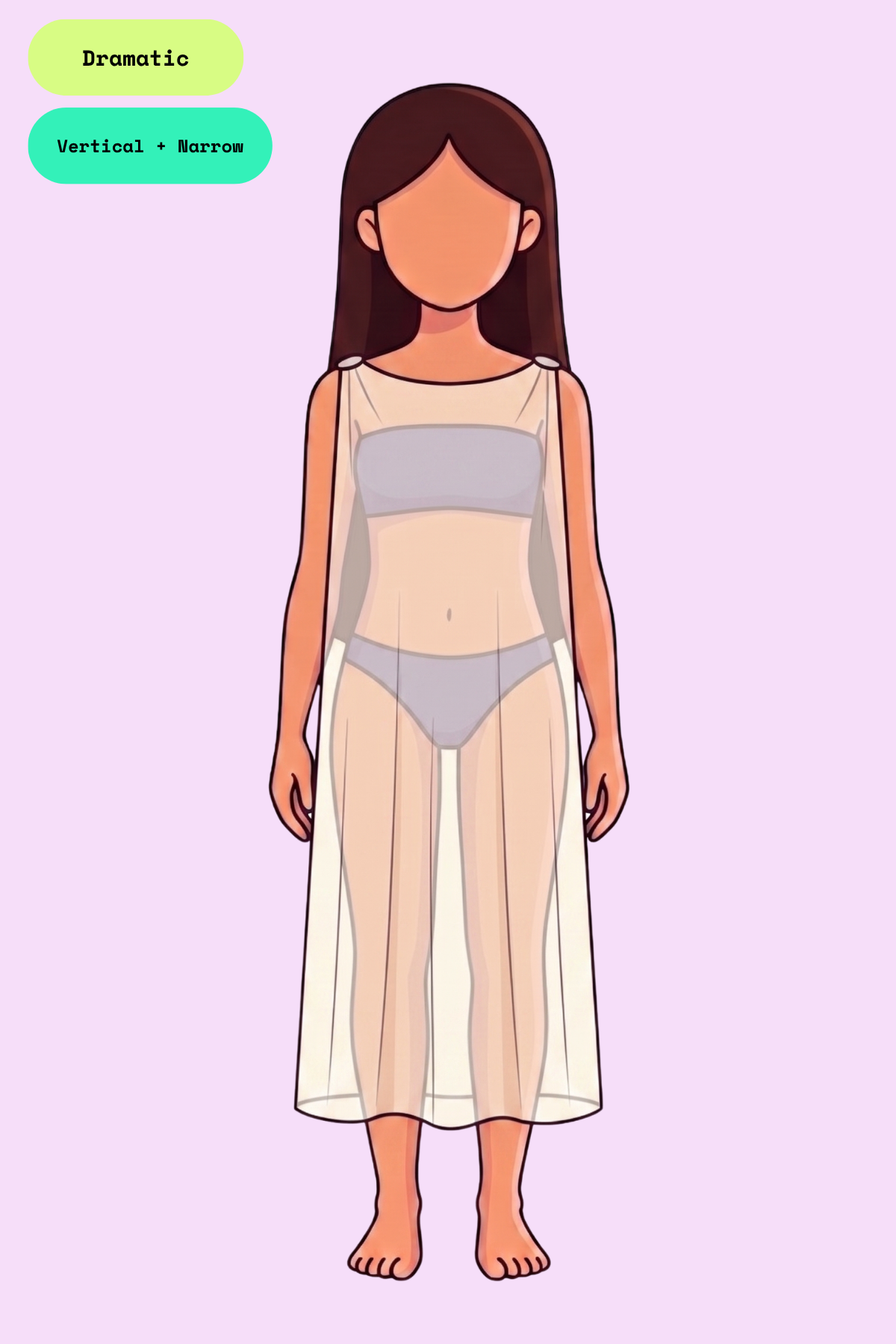
To find your Personal Line, you use a method involving imaginary fabric. Picture a length of silk chiffon, weighted at the bottom, draped from your shoulders. As the fabric falls, it will either drop straight down to the floor or be pushed outward by your bust and hips.
If the fabric falls in a straight line from the shoulder all the way down, your Dominant is Vertical. However, if the fabric is pushed out by your bust, cuts inward at the middle, and is pushed out again by your hips, your Dominant is Curve. This fabric is not meant to be a tight wrap or a literal outline of your body; it simply skims your frame as it falls to reveal your Dominant trait.
How to Do the Sketch
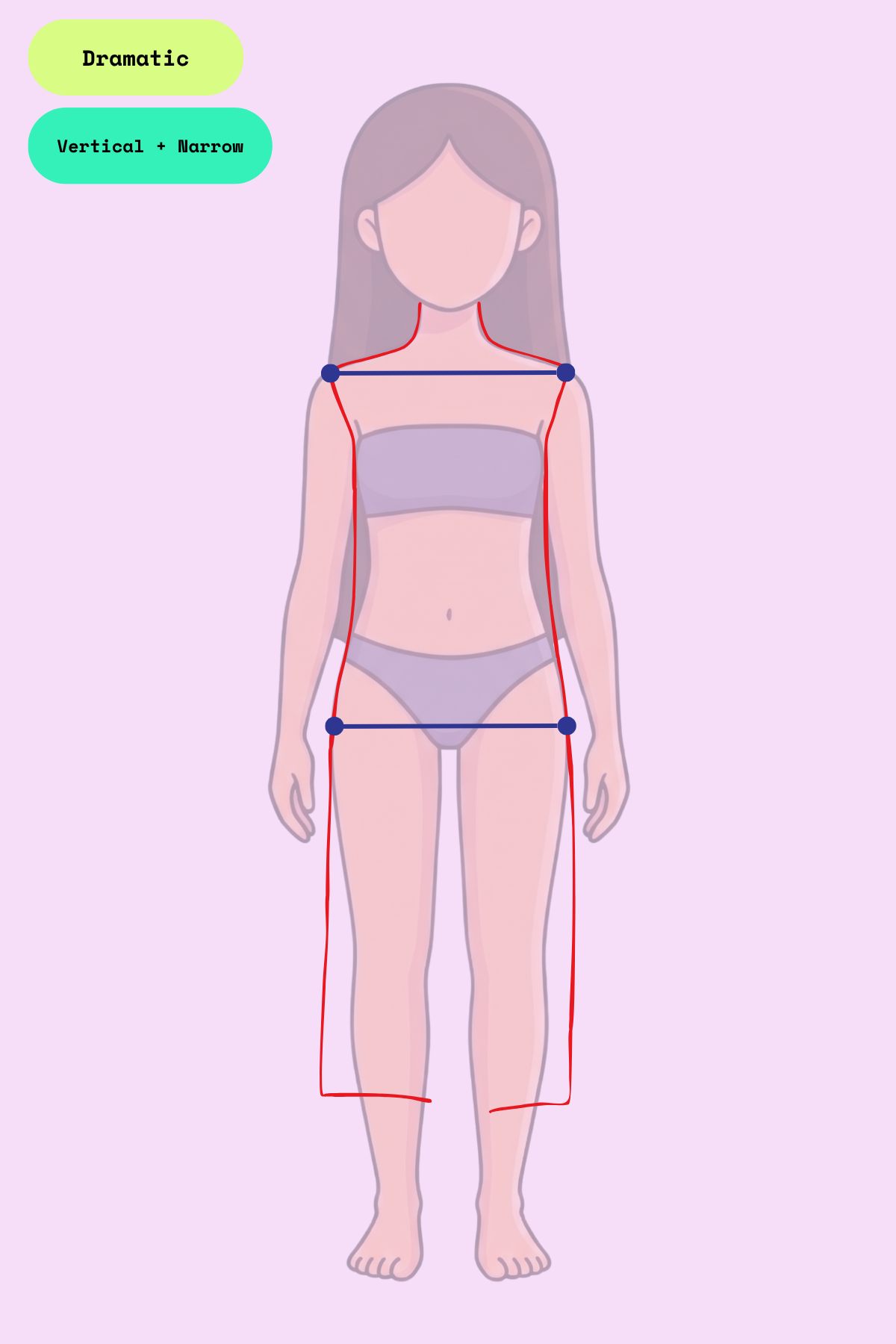
The next step is to sketch your Personal Line directly onto a photo of yourself. You’ll need a full-length, full-frontal photo taken in form-fitting clothes while standing in a relaxed pose with your arms at your sides. Set the camera at chest height about ten feet away and avoid using a mirror, as it can distort your proportions.
On the photo, trace where the imaginary fabric falls, starting at the edge of the shoulder where it meets the upper arm. A line that drops straight down indicates a Vertical Dominant, while a line that pushes out at the bust and hips shows a Curve Dominant.
It is important to trust only what the sketch shows you rather than going back to look at individual body parts. Height also plays a role: if you are 5'6" or over, your Dominant is Vertical with no exceptions. If you are under 5'6", your Dominant could be either Vertical or Curve. Once the Dominant is set, you sketch the Additional on top to see how it affects that specific area. Together, these two sketches form the Personal Line that your silhouette must follow.
The Dramatic Image Identity
Dramatic is the extreme sharp Yang Image Identity, defined by a Personal Line of Vertical plus Narrow. While most Dramatics are 5'6" or over, any height is technically possible. The Dramatic silhouette stays sleek and narrow so that the eye travels straight down in one unbroken vertical line. Whether the outline is tailored or flowing, the goal is for everything to move down rather than out.
When using the drape method, the imaginary fabric falls in a straight line from the shoulder and stays inside the shoulder width the entire way down. This reflects the Dominant trait of Vertical—an unbroken downward line—and the secondary trait of Narrow, which keeps that line contained. The resulting shapes are always long, vertical, and held within the width of the shoulders.
Reading Vertical Dominance in the Sketch
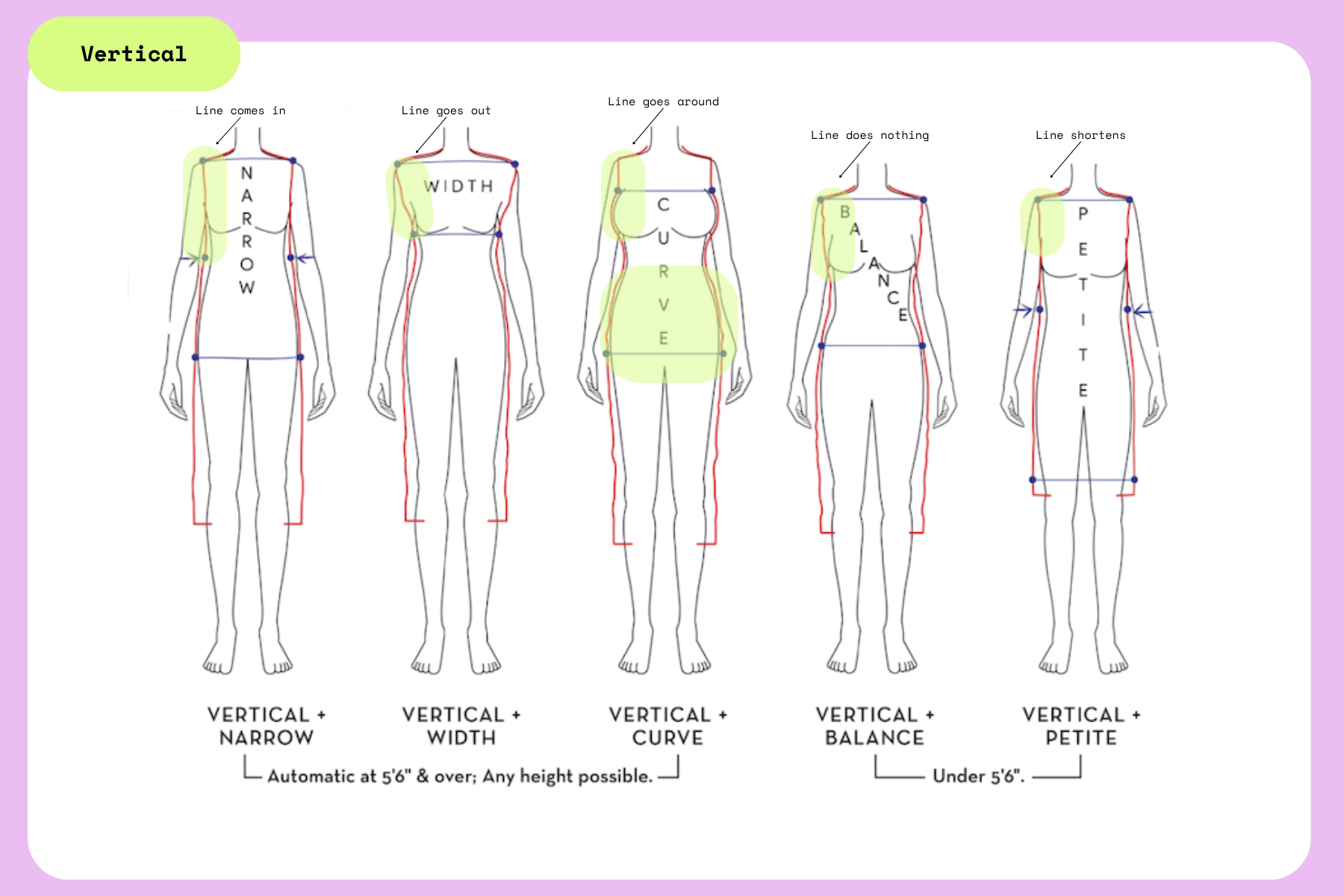
Now this is something I have noticed personally. I think you can find more specific information, a clue, by watching how the line leaves the shoulder dot. This specific section of the sketch looks different for each of the five Vertical Image Identities:
• Dramatic: The line narrows inward immediately after leaving the shoulder and then runs straight down.
• Soft Dramatic: The line comes down off the shoulder and curves around the bustline.
• Flamboyant Natural: The line moves outward from the shoulder, creating enough width that any curve at the bust sits inside that line before it drops down.
• Dramatic Classic: The line does nothing past the shoulder, showing no narrowing, widening, or curve.
• Flamboyant Gamine: The line is shorter as it leaves the shoulder, reflecting a more compact, smaller frame.
The Dramatic Sketch
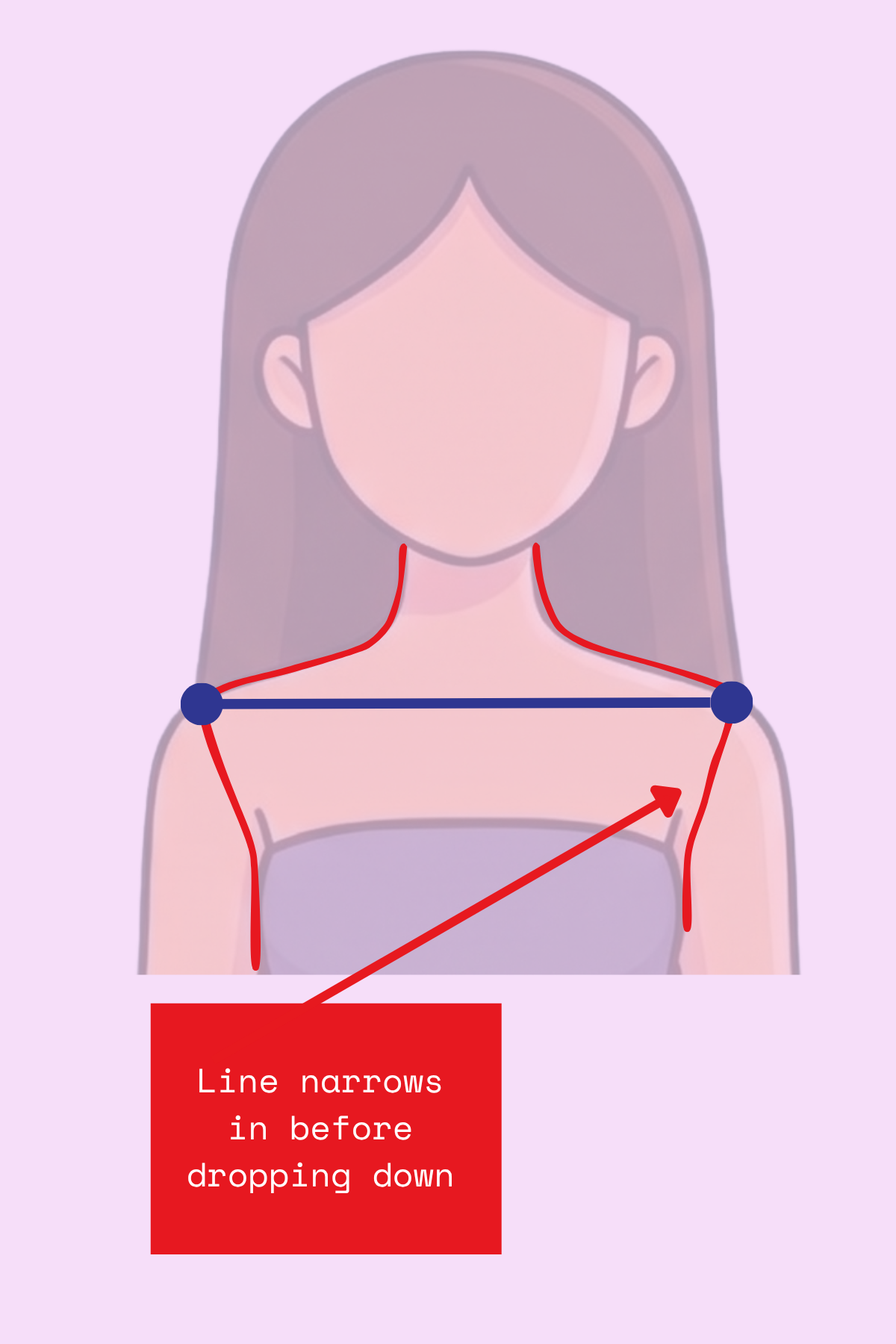
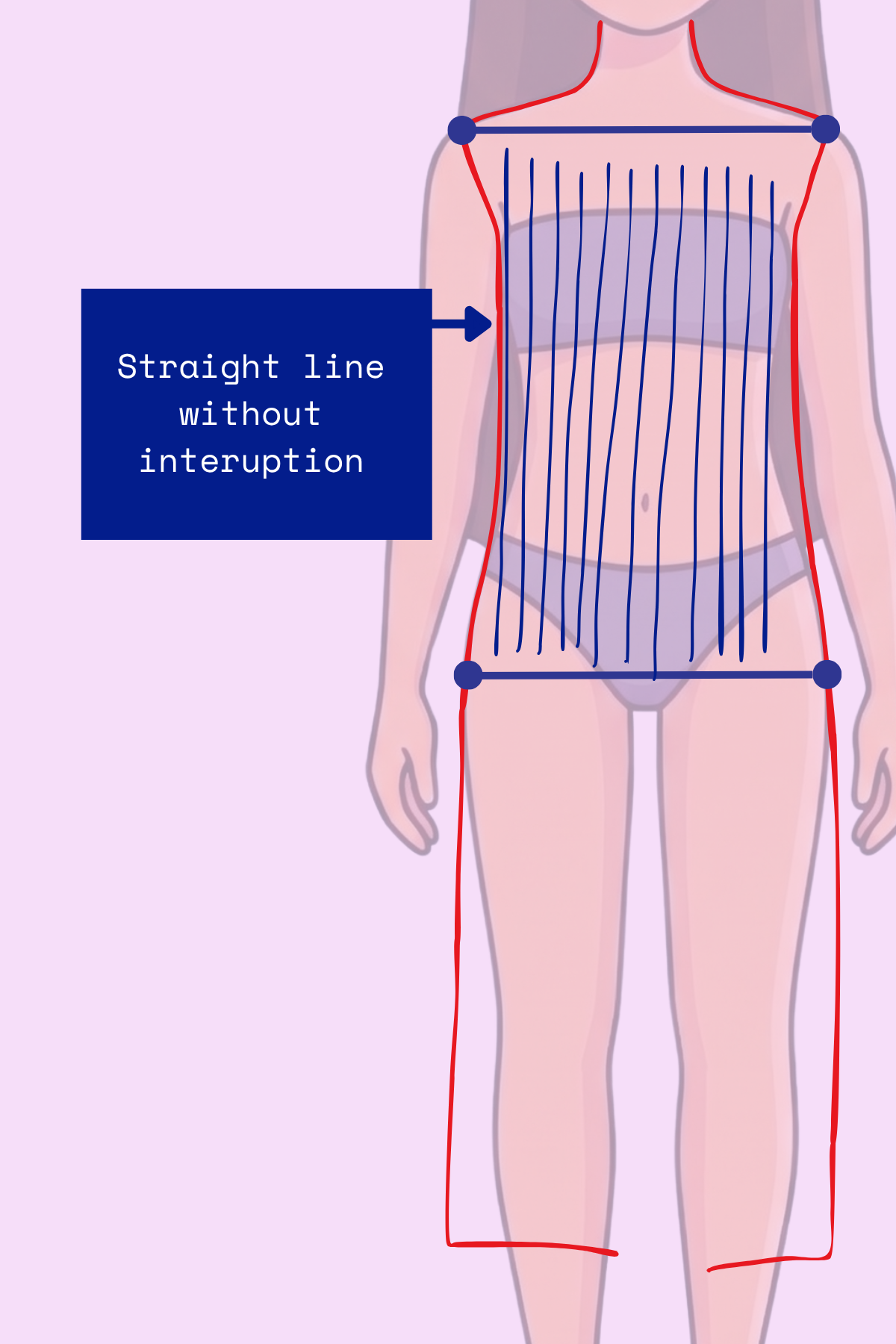
A Dramatic sketch requires two specific parts to be present. First, the line must narrow inward after the shoulder dot before it begins to drop. Second, that drop must be relatively straight and uninterrupted (we are human after all). It does not move dramatically outward at the bust or curve around any features like the hip. It also doesn't pick up any width along the way.
This uninterrupted line is the practical difference between a Dramatic and a Soft Dramatic sketch. One important note: having a bust does not automatically move you out of the Dramatic category; the real question is how the line reacts to it. If the bust pushes the line dramatically outward, and the waist and hip also impact the line, the sketch is likely Soft Dramatic. If the line continues straight past the bust without taking on any curve, the sketch is likely Dramatic.
The Seamstress Lens
You can also think about the Dramatic Personal Line through the eyes of a seamstress. A seamstress would smooth the fabric flat against the body, ensuring any pleating at the waist keeps the vertical line unbroken. No curve is added, and the line remains a clean, straight drop from the shoulder to the hem.
For a deeper look at this perspective, see A Seamstress Walks Into a Bar.
Other Ways to Discover Your Kibbe Type
While the sketch and fabric method is David Kibbe's current approach, there are other ways to find your type. The original method was the quiz, which used questions about bone structure, flesh, and facial features to determine a result. Later came asking online communities for feedback. I then built the photo analysis tool, which uses computer vision to read proportions and yin/yang from a photo.
I later updated to the current sketch approach by using 3D body mapping, sketch output, and virtual try-ons to show how different clothes look on your specific frame. Give it a go!
Related Articles

How to Know If You Are a Dramatic Kibbe: A Complete Guide to the Bold Body Type
Step aside, wallflowers,it's time to embrace the bold and striking essence of the Dramatic body type. With an angular frame that boasts long limbs and sharp, defined features, this type commands...
How to Do the Kibbe Personal Line Sketch for Theatrical Romantics
Information for this guide comes from David Kibbe's book The Power of Style. The book introduces the updated process for finding your Image Identity, which now includes the Personal Line.The Image...
How to Do the Kibbe Personal Line Sketch for Soft Naturals
This guide is based on David Kibbe's book The Power of Style, which covers the updated technique for finding your Image Identity with the Personal Line as its practical foundation.The Image Identity...