
How Japan's 3D Body Scanning Technology Is Changing Kibbe Body Typing
 Kibbe Body
A printout on my kitchen counter
My friend Jas came back from a two-week trip to Japan with the usual haul (a Muji tote, two bags of strange snacks, three skincare products I'd never heard of) and one item she pulled out last, like she'd been saving it.
It was a folded sheet of paper. On it: a small 3D rendering of her own body, photographed from four angles. Underneath, a grid of numbers and tiny diagrams I didn't immediately understand. A bra size. A panty size. A girdle size. Then five little bar charts labeled things like "torso shape," "root width," "breast set," "top taper," "bottom taper."
She smiled at my curiosity and explained. She'd walked into a Wacoal counter in a department store with no appointment. They put her in a private room, gave her a paper bra, and ran a scan that took three seconds. Three seconds.
I wondered how advanced this tech could be, and asked if I could borrow the printout. I sat with it for a long time after she left.
By that point I was ten months into building Kibbe Body. The Standard Photo Analysis was already live and is still in use today: an advanced measurement system designed to separate frame from flesh and yin from yang while pulling the key accommodation measurements a typing actually depends on. It worked. It just topped out around 76% accuracy on verified typings, and I'd been stuck there for months trying to push it past 80%.
But accuracy was only half of what I was after. The other half, honestly the bigger half, was making it easy. The Kibbe community has a real problem with what I think of as the search cycle: people spend months, sometimes years, cycling through all types, second-guessing every photo, retyping themselves every time a new outfit doesn't work, begging for consensus. The whole point of building this tool was to break that cycle. To get someone to a most-likely type fast enough that they could start exploring from there, instead of starting from scratch across all possibilities every time.
And there it was, on a piece of A4 from a department store in Ginza. A body, read as a structure, in three seconds. Just as a normal thing you can walk in off the street and do, in Japan, on a Tuesday afternoon.

What actually happened in that scanner
Let me walk you through Jas's experience, because the details are the point.
The service is called Wacoal 3D smart & try. Wacoal is one of Japan's biggest lingerie brands, and over the past few years they've been quietly installing these scanning booths inside department stores like Matsuya Ginza. You can find them in major cities. You don't need to be a Wacoal customer. You don't need to speak Japanese (the on-screen prompts have diagrams, and Google Translate handles the rest).
You step into a small private room with a glass scanning cylinder in the middle. You change into a paper bra they provide, tie up your hair, stand on a small platform, raise your arms slightly to the sides, and a ring of cameras sweeps around you. The whole scan is over in about three seconds.
What the machine actually does is capture 1.5 million surface points on your body. That's the resolution of the 3D mesh it builds of you, and it isn't a marketing number. From that mesh, it extracts:
The four standard measurements (overbust, underbust, waist, hips)
Eighteen additional measurements you've probably never thought about, like the distance from your bust point to the floor, the thickness of your thighs, your inseam
A calculated bust volume, which it uses to recommend a bra size, and this is the part that makes Wacoal's system actually different. Traditional bra sizing is just overbust minus underbust, which tells you almost nothing about the shape of what's actually inside the cup. Volume tells you something real.
Five body characteristic scores, on 1 to 5 scales: torso shape (flat to round in cross-section), root width (narrow to wide), close-set vs wide-set, top taper (the angle from bust to waist), bottom taper (the angle of the lower body).
Then it gives you a rotating 3D model of yourself that you can look at from any angle and prints a summary. You can walk out with your data and that's it.
The bra size it gave her, by the way, was different from what she'd been wearing for years. She'd been guessing from charts, the way most of us do. The scanner, working from her actual volume, put her one cup down and one band up. She tried both bras on. The scanner was right.
But the part that stuck with me wasn't the bra recommendation. It was that little grid of body characteristic scores.
Beyond Wacoal: a country-wide pattern
Before I get to the Kibbe connection, I want to zoom out, because the Wacoal scanner is one piece of a much bigger pattern in Japan, where 3D body modeling has been quietly absorbed into pretty much every layer of the fashion industry.
The ZOZO universe
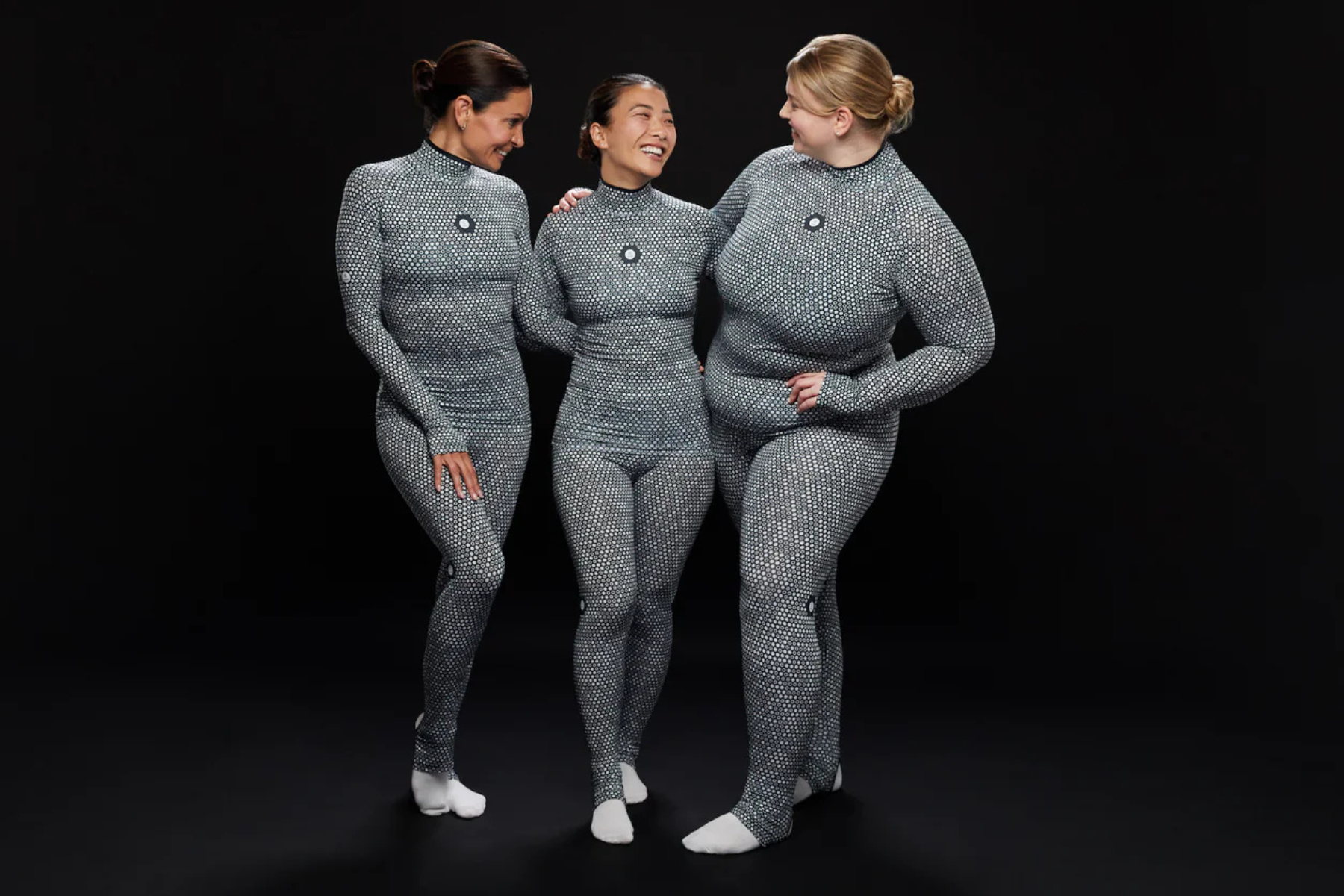
The biggest name here is ZOZO, which runs ZOZOTOWN, Japan's largest online fashion marketplace, hosting more than 8,500 brands. In 2018 they did something genuinely wild: they shipped, for free, a tight black bodysuit covered in white dots to anyone who wanted one. They called it the ZOZOSUIT. You put it on, stood in front of your phone, and the phone's camera read the dots from multiple angles to build a 3D model of your body. The whole process took a few minutes. No professional scanner required.
They later released ZOZOSUIT 2, which uses larger 6mm fiducial markers (50× the density of the original) and gets dramatically more accurate body curvature. They built ZOZOMAT, a printed paper mat you photograph with your phone to 3D-scan your feet, average error 1.4mm vs a laser scanner. They built ZOZOGLASS to capture your skin tone for cosmetics. And they built ZOZOFIT on top of all of that, an at-home body composition tracker that uses the same suit.
The wildest stat: ZOZO has accumulated over 100 million body data points from these scans, and uses that database to develop apparel sizing beyond the traditional S/M/L range. Customers can get fit recommendations across the marketplace by entering just their height and weight, because ZOZO knows what 100 million Japanese bodies actually look like.

Designers using 3D as a material
Beyond mass-market retail, there's a whole tier of Japanese designers who are using body scans and 3D printing as their primary medium. Yuima Nakazato, who trained at the Antwerp Royal Academy, used multi-material 3D printing to make muscle-fiber-like garment structures for his runway collection. Masaharu Ono of the Free-D studio created AMIMONO, a line of seamless 3D-printed clothing that's modeled algorithmically as if it were being knitted around a specific body. A studio called UTB has combined 3D scanning with SLS printing to make auxetic-fabric dresses fitted to the wearer's exact contours.

Virtual bodies, too
And then there's the other direction. Japan has been making fully CGI fashion models for years. The most famous is Imma, created by the Tokyo studio ModelingCafe, who's done magazine covers, brand campaigns, and runs her own social accounts. Her 3D-modeled head is composited onto a live body and background, and the result is convincing enough that most people don't realize they're looking at a render.
Put all of this together and you start to see the pattern: Japan is comfortable treating the body as a 3D object (yours, a customer's, a fictional one) and building fashion infrastructure around that comfort.
The philosophy hiding inside all of this
Here's what I think is actually happening, and why it matters for what we're doing.
In most of Western retail, the body is the variable. Brands design clothes in fixed sizes (S, M, L, sometimes XS through XXL if you're lucky), and the shopper's job is to find the size that compresses, stretches, drapes, or hides their body closest to what the garment expects. When something doesn't fit, the implicit message is that the body is wrong.
Japan inverts the equation. The body is the constant, the input, the starting point. The garment, the recommendation, the size chart, those are the variables that adapt around it. Scan first, dress after.
You can see this most clearly in the language Wacoal uses on that little printout Jas brought home. The five "body characteristics" (torso shape, root width, set, top taper, bottom taper) read more like structural descriptions than measurements. They describe the architecture of a body. They tell you something about how a body is shaped, beyond how much of it there is.
That's a totally different vocabulary from what we usually get in Western fashion. We get inches. We get cup letters. We get a number that pretends to be a size but actually varies by brand. We don't get a language for the underlying structure.
And the moment you have a language for structure, fashion stops being a sizing problem and starts being a fit problem. Which, if you've spent any time with David Kibbe's work, sounds extremely familiar.
Why this lit the bulb for Kibbe Body
If you don't know the Kibbe system, the very short version: David Kibbe spent decades developing a body typing framework (he prefers the term Image Identity) that classifies people into ten Image IDs (originally thirteen) based on three structural qualities. Bone structure (sharp/yang vs rounded/yin). Flesh distribution (lean vs soft). Vertical line (long vs short vs balanced).
Once you know your type, the system gives you specific guidance about what kinds of silhouettes, fabrics, cuts, and lines will work with your natural architecture, going with the grain of your body instead of fighting it. People who get a correct Kibbe type often describe it as the moment they finally understood why some clothes they "should" have looked good in always felt off, and why other things they'd written off as impractical actually flatter them.
The catch, and it's a big one, is that Kibbe typing is notoriously hard to do yourself. The original method involved a quiz, a full-length mirror, and a lot of self-assessment about whether your shoulders are "blunt" or "sharp," whether your flesh is "succulent" or "taut," whether your vertical line reads as long or short. People mistype themselves constantly. The Fabric Drape method seems to have only added to the confusion, with arguments over where the drape line should actually start. To this day the forums are full of people who thought they were Soft Naturals for years and then realized they were Romantics. The whole system is structured around objective body realities, but the only assessment tool we are told to use is our own eye.
This is exactly the gap that 3D body modeling closes.
Think about what the Wacoal scanner is already doing. It's reading bone structure (root width, torso shape). It's reading flesh placement (the volume calculation, the body characteristic scores). It's reading proportion (eighteen measurements that capture how your body is laid out, beyond how big each piece is). And because the output is a full 3D model, it's reading silhouette in exactly the way the Fabric Drape method requires: where your body pushes fabric outward, and where it lets it fall straight down. All of that maps almost one-to-one onto what both Kibbe methods (the traditional quiz and the modern Personal Line sketch) ask you to assess for yourself.
Wacoal's machine was built to sell bras, and body typing was never the goal. But the underlying capability of reading a body as a structure is the missing piece of every Kibbe self-assessment that's ever gone wrong.
So that's the bet behind the 3D Analysis on this site. If Wacoal can capture 1.5 million data points and turn them into a five-category body characteristic report for the sake of a better-fitting bra, then a similar approach can be used to identify a Kibbe type with more confidence than any mirror-and-quiz combination or sketch could ever produce.
Japan showed it works. The technology is here. The only thing missing was someone pointing it at the right framework.
And Kibbe's method itself evolves. The original quiz came out in 1987. The Fabric Drape method, with its sketches and Personal Line, arrived in 2025. If we are on the same trajectory, the next big leap probably lands somewhere around 2054 (David will be in his 90s). But I think it's already here, and it looks like this: a 3D body model doing the structural read directly, instead of asking you to do it for yourself in a mirror. This is how Kibbe typing doesn't get left behind. This is how it leads.
How Kibbe Body applies the Japanese approach
This is the part of the post where I tell you what the tool actually does, so I'll keep it short and let you try it for yourself. The system runs on an in-house measurement model trained on verified Kibbe Image IDs.
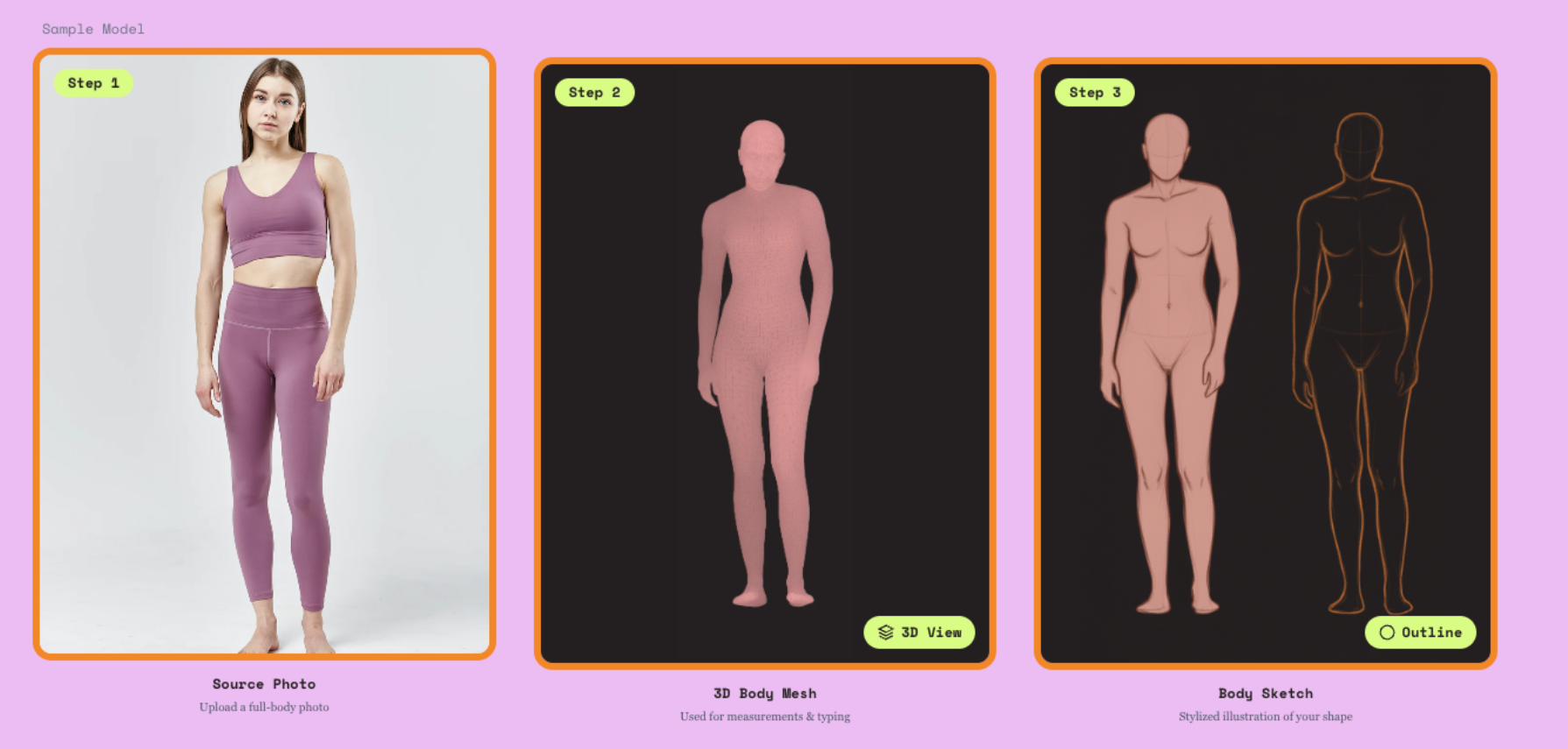
You upload a photo (one full body front shot is enough to build a usable 3D mesh). Following instructions clearly or adding more of the photo variations just improves accuracy.
From those photos, the system reconstructs a 3D model of your body focused on structure instead of photorealism, similar to the way Wacoal's system works. From that model it extracts the metrics that answer both Kibbe methods at once:
Bone structure cues: shoulder width relative to hip width, the angle of your collarbones, frame proportions, the bone structure of your face when the face shots are included. The kinds of features the original quiz asks you to assess.
Flesh distribution cues: how soft tissue is layered over the underlying frame, where it pools, where it's lean. Also from the quiz.
Personal Line cues: where your body pushes fabric outward and where it lets it fall straight, which determines your Dominant (Vertical or Curve) and your Additional (Narrow, Width, Curve, Balance, Petite, or Double Curve). The Fabric Drape method, answered directly because we already have your 3D model.
The output is your Kibbe Type (Image ID) with a confidence score, a 3D body mesh, a body sketch outline, and a virtual try-on showing your own body in each Image ID's signature silhouettes.
The accuracy gains have been meaningful. The Standard Photo Analysis tool, working from flat photos alone, lands around 76% accuracy against verified Kibbe typings. Once I layered 3D body modeling on top of that pipeline, accuracy moved up to roughly 86% on verified typings, and the friction on the user end mostly collapsed. The 3D model does the work, and it does it more consistently than a human ever could.
The Wacoal printout is the model. We just pointed the camera at a different question.
The bigger picture
I think we're at the very early edge of a much bigger shift in how fashion works, and Japan is several steps ahead of the rest of the world in showing what that shift looks like in practice.
When the body becomes the input, when "what does my actual structure look like" becomes a question with a tractable answer, a lot of downstream stuff changes. Returns drop, because clothes fit. People stop self-flagellating about not fitting into arbitrary brand sizing. Type-based systems like Kibbe become genuinely usable instead of being a hobbyist puzzle. Custom-fit clothing becomes affordable. Online shopping becomes something you can do with confidence instead of with three sizes in your cart "just in case."
And maybe more importantly, the body-as-problem framing that's quietly poisoned a lot of fashion retail for decades just… stops being the default. The body is the starting point. The clothes are what get figured out around it.
Japan figured this out first. They built the infrastructure quietly, in department store basements, and smartphone apps, and 3D-printed runway pieces, while the rest of the industry was still arguing about whether S/M/L should be more inclusive.
When Jas handed me that Wacoal printout, what I was really looking at was a glimpse of what fashion looks like when you start from the body. That's what we're trying to build here, for the specific question of Kibbe type (which attempts to do the same thing).
If you want to see what your own structural read looks like, you can try the tool here. And if you ever find yourself in Tokyo with an afternoon free, go find a Wacoal counter. Walk in. Get scanned. Bring home the printout. You'll see what I mean.
Related Articles
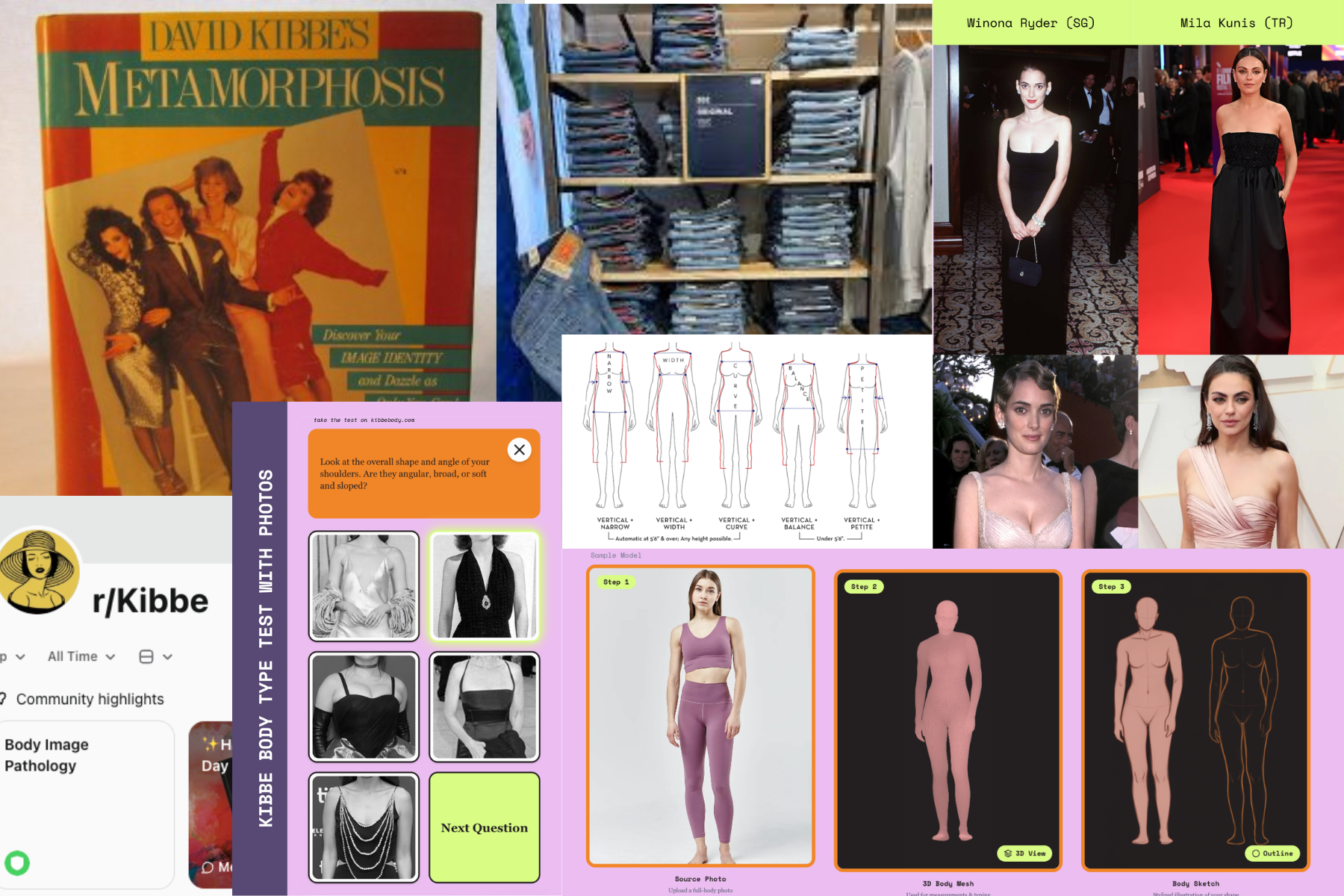
How to Find Your Kibbe Body Type: Every Method, Compared
If you've fallen down the Kibbe rabbit hole at any point in the last forty years, you've probably tried more than one way to figure out your type. Maybe you bought a used copy of Metamorphosis off...

Shoulder Dot Placement in the Kibbe Personal Line Sketch
Let's talk about something that comes up constantly, quietly causes a lot of confusion, and genuinely affects how accurate your sketch reads: where do the shoulder dots go?This is one of those topics...

A Devoted Reader's Notes on the Kibbe System
David Kibbe built something important. The core insight at the heart of his system is that you should feel beautiful, and that clothes should be chosen to accommodate the body wearing them. This...