
A Devoted Reader's Notes on the Kibbe System
 Kibbe Body
David Kibbe built something important. The core insight at the heart of his system is that you should feel beautiful, and that clothes should be chosen to accommodate the body wearing them. This philosophy has shaped how a lot of people think about getting dressed.
What he did is not unlike what Newton did with gravity. Newton didn't invent gravity, gravity was already there, pulling apples down for the entire history of the universe before anyone wrote it down. What Newton did was see it, name it, and give us a way to talk about it. Later, others measured it. Refined it. Built rockets with it. None of that diminished Newton. It honored him.
One side effect of building something that endures: the name grows into the work. When we say "Newton," we mean both the man and the physics. Same with Kibbe. When I say Kibbe in this post, I am referring to the system. When I say David, I mean the person who founded it.
That's how I read David's work. He saw something real about bodies and clothing. He named it in 1987 (long before I was born). He gave us the framework. The work of building on that, measuring it, refining it, translating it for people who think differently than he does, is what comes next in any solid system.
I also have an English Rhetoric background, that was my degree. And it's about taking complex ideas and making them easy to access, digestible, understood. (I later taught myself to code, which is really the same impulse applied to a different medium.) So when I read David, I read him the way a literature class reads a poet, or the way a physicist reads Newton. The original is sacred text. The translation is what helps it travel.
A note on this site versus these notes. The Kibbe Body site itself is built as close to David's system as I can get it. The tools, the typing, the recommendations, all of it follows the framework and rules.
These notes are different. This post is transparency on my thinking, theory. It's my read, my translations, my interpretations. Other blog posts on this site that explore my ideas (rather than strictly apply David's) are marked the same way. When you see me theorizing, you'll know. When you see me typing or styling, that's the system.
You'll see my translations diverge in a few places, especially if you engage with me directly, on Reddit, in emails, in conversation. None of these are disagreements with what David sees or says. They're translations of his published work and public material. Transparency matters to me, and this post is one of the places that shows up.
I'll keep this post updated as my thinking moves. The list will grow. The list might shrink. The system will keep evolving, and so will I. So will you.
Now, if you are a Kibbe purist, this is your warning, you may feel emotions when reading this. Proceed with caution.
1. It's Okay to Waver Between Two Types
Kibbe can lean toward conviction. People get so determined to find their type that they never commit to it, never start dressing for it. Wavering between two starts to feel like you're doing it wrong.
I don't think wavering is a problem. I think it's part of the exploration.
The types are more similar to each other than people think. The body is a small canvas, there's only so much room it takes up, and a garment only has so many levers it can pull (necklines, hems, sleeves, drape, fabric, structure) to accommodate what's underneath. If you're stuck between two of them, you're not failing the system. You're correctly identifying something in your frame.
I think you should stop staring at yourself and start styling yourself. Dress for what you already know. If you've found your Dominant you're halfway there. That's the bigger half of your Personal Line. Start there. Try silhouettes that honor your Dominant. Play with what works and what doesn't. Let real clothing on your real body show you where your Additional lands.
I have a whole post on this called What To Do If You Are Between Two Kibbe Types, but the short version: getting yourself down to two is already an enormous narrowing. You've eliminated eight types worth of silhouettes that don't fit you. Be okay in the overlap. Borrow from both. Play with style until you are sure.
2. Outside Eyes Help. Use Them.
David's modern philosophy emphasizes that only you (and he) can determine your type, that typing is a journey of self-discovery and external typing isn't really typing.
I understand the spirit of this, and the motivation behind it. He's pushing back against the era where people got "typed" by stylists who issued verdicts. He wants you to develop your own eye and own the result. That's right.
But developing your own eye doesn't mean working in a vacuum. The material can often create confusion. Outside eyes help. A professional analysis. A friend with a good eye. A stranger on Reddit. A stylist. Even an algorithm trained on verified typings. None of these replace self-knowledge, but I think they can break through bias in a way self-reflection alone often can't.
You're the one who lives in your body. You're the one who has to dress it every day. But you don't have to figure it out alone.
3. The Automatic Vertical Might Not Need to Exist
I used to think the threshold where Vertical becomes automatic should be raised by an inch or two. I still think 5'6" sits a hair low. But I've landed somewhere different: maybe a hard cutoff shouldn't exist at all.
Every type has outliers. That's not a flaw in the system, or a mistake on David's part. That's just what distributions do.
A good system doesn't need strict lines to be reliable. It needs a mean, a range, and room for the edge cases. A statistical model, basically. And if you go back to Metamorphosis, that's closer to how David actually wrote it. Height shows up as "usually" and "over," or "typically under." Not hard cutoffs.
The taller someone is, the more likely they have an unbroken Vertical line. But it's a gradient, not a rule. Beyoncé is verified as Romantic, a Curve Dominant, and she's 5'8".
That said, the analysis tools on this site apply David's rules as written. This writing is my theory, not what the system uses.
4. Celebrities Are the Standard, Not the Trap
A system needs a shared reference point. Not so you can dress like someone famous, not so you can borrow their style, but so that two people talking about the same type are actually talking about the same thing. Without a baseline, the system lives in one person's imagination and nowhere else. That's not a system. That's a private language.
Celebrities are that baseline in Kibbe. They're the reason someone in Tokyo and someone in Ohio can look at the same body and land on the same type. They're the reason the system is teachable at all.
David's concern, distaste, and pivot away from typing celebrities is fair in one direction: people get so fixated on matching a celebrity's look that they forget they're supposed to be learning what works for their own body. That is a real trap. But the fix isn't to remove the reference points. The fix is to use them correctly.
His practical objections also don't hold up the way they did in 1987. Google heights are rarely wrong. Photos are styled sometimes, not always. And we don't live in a world of red carpets and press shots anymore. We live in a world of TikToks, airport footage, gym photos, Instagram stories, and thousands of candid frames of almost every famous person alive. We have more access to celebrities in their most natural, unstyled state than at any point in history. The "faulty information" argument was stronger before all of that existed.
There's also something worth naming plainly: David has retyped celebrities. Multiple times. If celebrities are the shared standard, he can be proved wrong. If there's no shared standard, he can't be.A system with no external reference points is unfalsifiable, and unfalsifiable systems are not systems.
The celebrities on this site are there as reference points, not role models. Learn from their lines. Dress for your own.
5. Silk Chiffon is Beautiful, but a Tight T-Shirt Works Better
In Power of Style (2025), David introduced the Personal Line sketch as the new method for finding your type. You take a full-body photo in fitted clothing. You imagine silk chiffon, weighted at the bottom, draping from your shoulders. If it falls straight, you have Vertical. If it gets pushed out, you have Curve. The sketch traces where the chiffon falls.
It's a gorgeous metaphor. But here's the honest experience most people have: they've never owned silk chiffon. They don't have a strong mental model for how it would actually behave on their body. Asking someone to picture an unfamiliar fabric and then trace where it falls is asking them to do two abstractions at once.
When I draw the personal line, I put it right on the silhouette. David's method has the line drift slightly off the body, following the imagined drape of chiffon. Mine traces the body itself. Here's the thing: whether the line is on the silhouette or an inch away, it's tracing essentially the same shape. One version is just clearer than the other. One is concrete, one is abstract.
So I lean concrete. I picture a tight t-shirt extended to cover the body. We can all picture what our bust and shoulders do in a tight t-shirt. We can all picture what our waist and hips do in a tight skirt. If we're looking for accommodation in fabric, I don't think we need to go abstract.
Why the close line works. The Personal Line is meant to be read as one continuous silhouette, shoulder to hem. But over time, my eye lands in the same places first, the short stretch right off the shoulder, the way the line cuts in at the waist or pushes outward at the bust. These small clues hint at the type before I've taken in the rest of the sketch. Reading them on a clean, close line is easier than reading them off an imagined chiffon drape. I have a full breakdown of where my eye goes for each of the ten types in a Reddit post.
If you understand chiffon, use chiffon. If you don't, draw it on your frame. The answer is the same.
6. A System Should Be Usable By Everyone Who Tries It
This one is more philosophical, but it's the one that drives most of what I build.
A real system is something anyone can pick up and apply with confidence. The rules clear, the path traceable, the answer arrivable. That's the version of Kibbe I want to keep building.
David's framework is more than capable of holding that vision. He gave us all the pieces, the structural principles, the typing logic, the styling guidance. The work, as I see it, is to translate those pieces into tools and language anyone can use on their own. Not to replace David's eye, which is irreplaceable, but to put as much of the system into the hands of the person dressing themselves as possible. Creating clarity instead of confusion.
Where I think this has gone wrong. There are pockets of the Kibbe community whose ideas stem from the rules of the Kibbe Facebook group, which is publicly listed on Facebook and whose rules have been widely discussed and circulated across Reddit and other style communities. The group's role is to study what he teaches, not to interpret it. You can't discuss anyone's work except David's. You can't disagree with David, especially about celebrities. The only way to find your ID is to purchase the book and do the games and exercises inside. Posting pictures of yourself or trying on clothing is discouraged. Modern celebrities aren't for discussion because they don't have "star image" anymore. What happens in the group stays in the group, you must never discuss or share it.
These rules push the system away from being usable, in my view. It also doesn't align with what I believe love-based beauty is. To me, love-based beauty is open, it's transparent, it trusts people and their recommendations. It's looking to others for inspiration. It's clear communication and community.
The more people who can confidently use Kibbe to dress the body they have, the more love-based beauty exists in the world. And to me, that should be the goal. I don't believe in gatekeeping.
7. The Evolution from Accommodation to Awakening
David's modern system includes a lot of inner-journey work, games, exercises, a guided journey through self-acceptance, Pull Up Your Awe, Susan's Breath, the Three Loves, and an entire movie list.
I agree the inner work matters. I think you should be one with yourself, understand your personal bias, really sit with how you see yourself and experience the world. That work is real, and it might be exactly what David has evolved Kibbe into.
But for me, the order is the opposite. I didn't want to sit and breathe and untangle bias before I could get dressed, that's therapy-territory work, years of it, maybe some social reconstruction along the way. What actually helped me break down the inner stuff was starting with the outside answer. Getting an objective description of my body. Gaining confidence in dressing harmoniously with my lines. The inner shifts followed the outer answers, not the other way around.
The words themselves carry bias. "Width" sounds heavy. "Gamine" sounds odd. People come in worried the labels are critiques before they've even seen what the labels actually describe. But the outside read flips that. Width is the model you've always admired. Gamine is the coolest style in the room. The vocabulary stops being a verdict and starts describing what you already love.
I don't think you need to start with inner work. It's a lot to take on for someone who came here just to learn how to dress better.
And if David has fully evolved Kibbe into an inner-journey practice to break down bias, then we still need a separate system that tells us what to wear. The practical questions, what does my body need clothing to accommodate, what is my yin/yang balance, is what most people are looking for when they look up Kibbe. A good seamstress could give you the same valuable information in thirty minutes. I lean into this in A Seamstress Walks Into a Bar, a mental model for what I think Kibbe is actually doing at the practical level.
If the games and the inner work help you get there, brilliant. But I don't think you need a spiritual awakening to figure out that fabric drapes differently over a Romantic body than it does over a Dramatic one. You just need to learn what to look for.
8. The Future of Typing is 3D, Not Pencil and Paper
David's first book came out in 1987. His second came out in 2025. That's a 38-year gap. The signature new tool he introduced in the second book is the sketching method, a hand-drawn outline of your body with imaginary silk chiffon draped from your shoulders.
Now fast-forward another 38 years to 2064. Do I think we'll still be hand-sketching our outlines? I don't.
We're already heading toward a world where clothing is custom-made from body scans, where bra fittings happen inside three-second 3D scanners, where the body itself becomes the input that retail adapts to instead of the other way around. (Japan is most of the way there already, I wrote about that in my Japan post.)
Kibbe is fundamentally about understanding the geometry of your body. That's exactly the kind of question 3D modeling is designed to answer. So my thought is that the Kibbe system should be at the front edge of body-mapping technology, not stuck in an outdated era. The framework is timeless if the tools keep updating.
That's why so much of what I've built is 3D-first. I love that the system constantly evolves, it would be a shame to stop now.
9. Clothes Still Carry Type, They Just Carry It Differently
David has said in recent years that clothing doesn't really have IDs anymore. His reasoning: forty years ago, garments were built with structure that imposed shape on the body, darts, seaming, shoulder pads, narrow sleeves cut close to the arm. That structure created its own lines, which either aligned with your body or fought it. Today, most clothing is made with stretch and softer construction, which means it adapts to whatever body wears it. So in his view, the typing of garments has mostly dissolved.
I read this differently.
It's true that the average garment is more forgiving than it was in 1987. Stretch denim, stretch knits, drapey rayon, all of it accommodates more bodies than the structured clothing of David's first book did. But the principle of accommodation hasn't gone away. It's just shifted from "whole-garment structure versus your body" to "specific elements versus your body."
A narrow sleeve still isn't going to work for a Soft Natural. As a Soft Dramatic, I'm not going near a dress that buttons-up at the front.
The question isn't whether clothes have IDs the way they did in 1987. They don't. The question is whether they still carry elements that work with or against specific bodies. They do. Necklines. Sleeves. Hems. Volume placement. Fabric. Drape direction. These haven't gone away. They're just doing the work that whole-garment structure used to do.
10. You Can Love the Method and Not Love the Styling
David has a very specific aesthetic sensibility. You can see it in his books, in the transformations, in the recommendations he posts. It's polished, classic, a certain kind of grown-up. It's beautiful in its own way, and it works for many of the people he works with.
But not everyone wants to dress like that.
People who've gone shopping with David have publicly critiqued some of his selections. People have critiqued the styling in his books, the transformations, the looks he posts. That's a fair conversation to have.
Part of what's going on, I think, is a gap between David and most of the people reading him now. There's an age gap. There's a generational fashion gap. The world that produced David's eye is different from the world most of us are dressing for. I'm over here dreaming about a Staud mini dress with Bratz-inspired pumps. That's the moment I live in.
The good news is that the method and the styling can live separately. You can take David's framework, what your body needs to accommodate, your yin-yang balance, what silhouettes work with you instead of against you, and apply it through a stylist whose taste you actually love. There are so many great stylists working now whose eyes might align with yours better than David's does, and finding one whose aesthetic clicks with your type is one of the best practices in this whole world.
You don't have to agree with David's styling to know his method of yin-yang balance and clothing accommodation is genius. The framework is the framework. The aesthetic is taste.
11. You Don't Have to Dress in Harmony
This is the one that might surprise you, coming from me. Everything on this site is built to help you dress in harmony with your lines, and I stand by that completely. Find your Kibbe type, learn the silhouettes that accommodate your body, layer colour theory on top, learn the makeup that actually works for your features, and you will be about as conventionally attractive as you can get. That is the promise of the system, and it holds.
But as conventionally attractive as possible is not the only goal worth having.
Sometimes the best style doesn't come from harmony at all. It comes from juxtaposition. From intention. From wearing something because you chose it, not because it accommodates your frame. A sharp line on a soft body. A volume your type would never call for, worn on purpose. The thing that on paper shouldn't work, worn with enough conviction that the friction becomes the whole point.
Here's the thing: once you know your lines well enough to dress in harmony, you also know them well enough to break from them on purpose. Harmony is what the system gives you, and it's where I'd tell anyone to start. But it's a starting point, not a ceiling. One way of dressing is about looking as good as the rules allow. The other is about saying something. Both are valid. You get to decide, outfit by outfit, which one you're reaching for.
Where We Agree on Everything That Matters
To name the obvious: these points are translations, not rebuttals. The framework David Kibbe built, that clothing should accommodate the body it's worn on, that beauty is love-based, that the goal is to dress with the natural shape of a person and not against it, is a generous, useful, and emotionally intelligent way to think about getting dressed. Everything else here is small relative to all of that.
This is a living document. I'll add to it as my thinking moves. The system is bigger than any one of us, including the man who created it, and the best way to honor work this good is to keep reading it carefully, translating it openly, and building on it with respect.
Related Articles
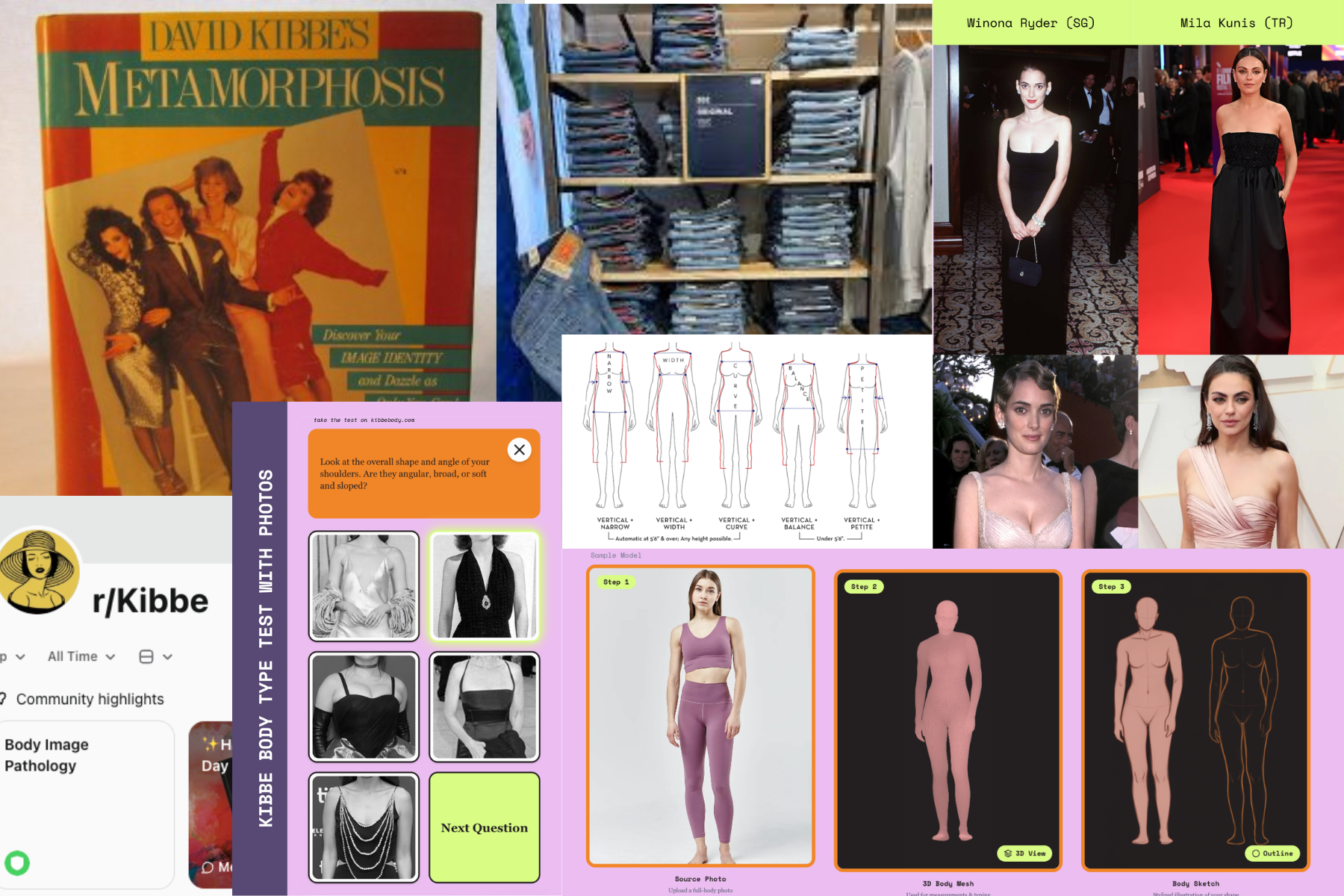
How to Find Your Kibbe Body Type: Every Method, Compared
If you've fallen down the Kibbe rabbit hole at any point in the last forty years, you've probably tried more than one way to figure out your type. Maybe you bought a used copy of Metamorphosis off...
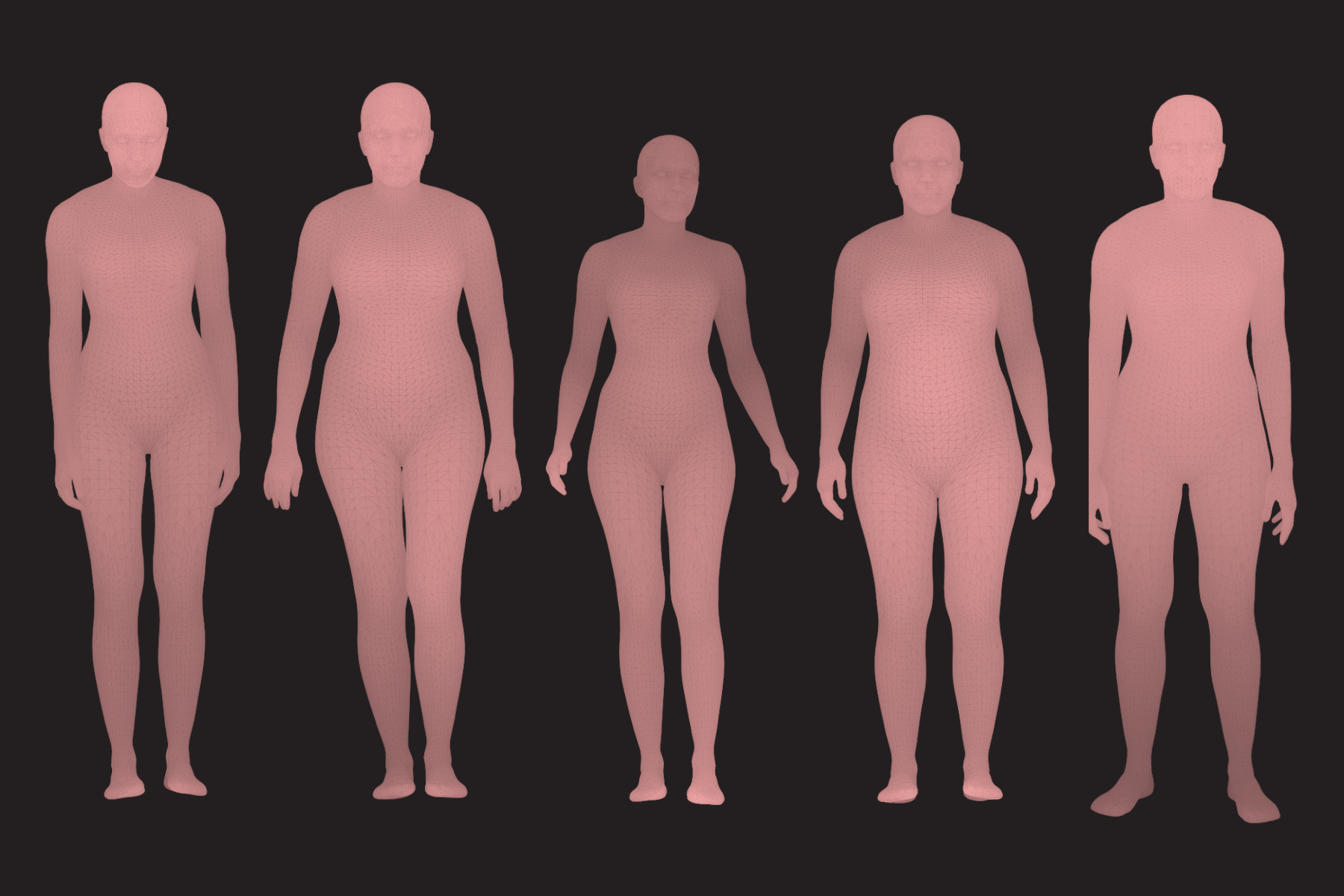
How Japan's 3D Body Scanning Technology Is Changing Kibbe Body Typing
A printout on my kitchen counterMy friend Jas came back from a two-week trip to Japan with the usual haul (a Muji tote, two bags of strange snacks, three skincare products I'd never heard of) and one...

Shoulder Dot Placement in the Kibbe Personal Line Sketch
Let's talk about something that comes up constantly, quietly causes a lot of confusion, and genuinely affects how accurate your sketch reads: where do the shoulder dots go?This is one of those topics...