
How to Find Your Kibbe Body Type: Every Method, Compared
 Kibbe Body
If you've fallen down the Kibbe rabbit hole at any point in the last forty years, you've probably tried more than one way to figure out your type. Maybe you bought a used copy of Metamorphosis off eBay for $400. Maybe you spent a Saturday at Levi's pulling every cut off the wall. Maybe you posted on Reddit and got six different answers from six different strangers.
You're not alone, and you're not doing it wrong. Kibbe typing has genuinely been hard, and the methods people have used to crack it tell a story about how the system itself has evolved.
Here's roughly how we got from there to here.
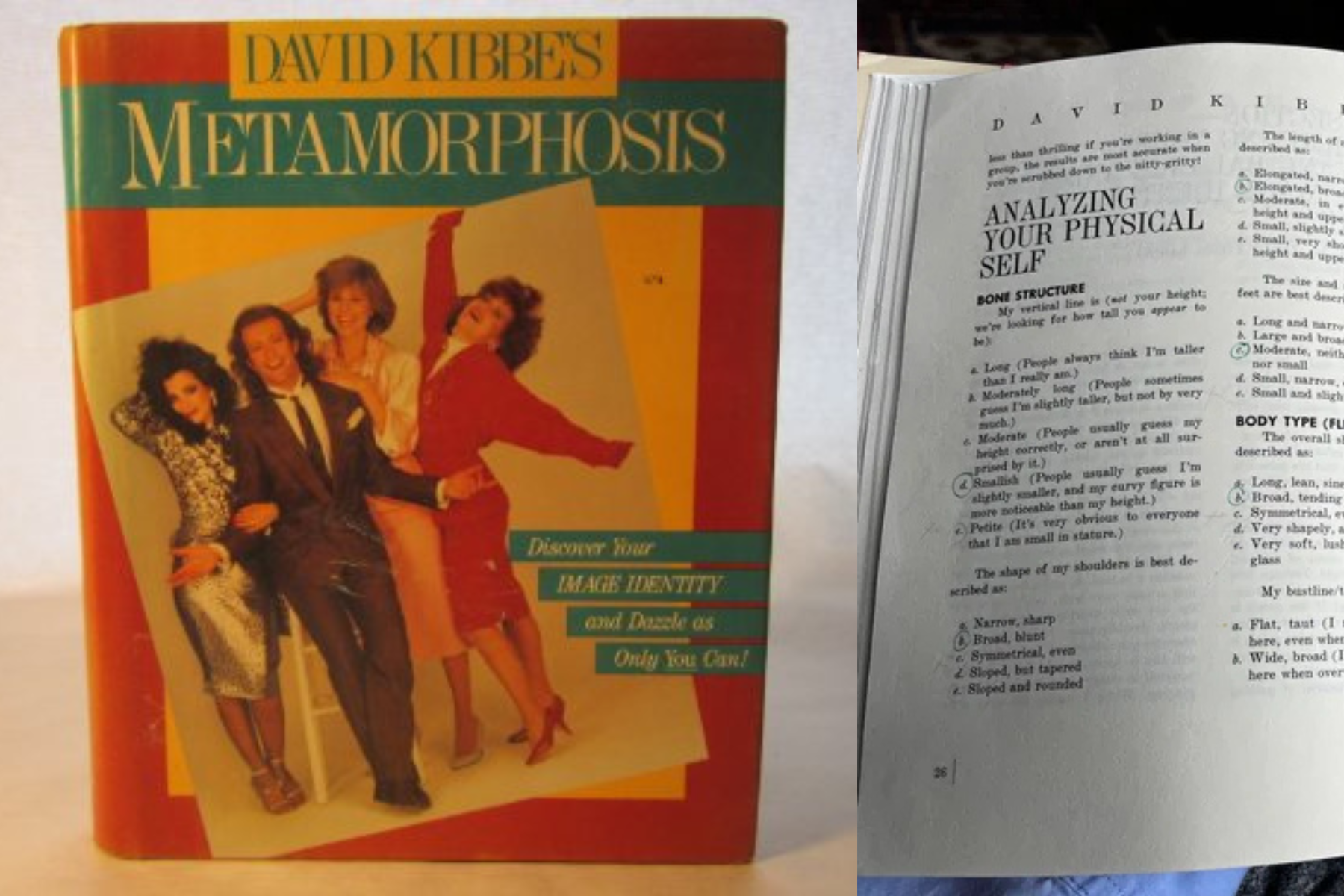
1. The Original Metamorphosis Quiz (1987)
It all started in David Kibbe's Metamorphosis. Fifteen questions about your bone structure, body flesh, and facial features. You answered A through E, tallied your letters, and matched the result to one of the 13 original types.
This was revolutionary in 1987. Nobody was talking about body lines or yin–yang balance in mainstream style books. Kibbe was doing something nobody else was doing, and the quiz was the gateway.
But it had limits. Every question carried equal weight, which meant your hand size counted the same as your shoulder structure. Your nose mattered as much as your overall vertical line. People got results that felt off, and they couldn't always figure out why.
David himself has moved away from this approach. In Power of Style (2025), he literally writes "NO BODY PARTS." He's no longer trying to categorize you feature by feature, he's trying to help you see your whole silhouette. The original quiz is a beautiful artifact, but it's not how he types people anymore.
2. The DIY Phase
Once the Kibbe community started forming, people got creative. Some of my favorite methods were the lowest-tech.
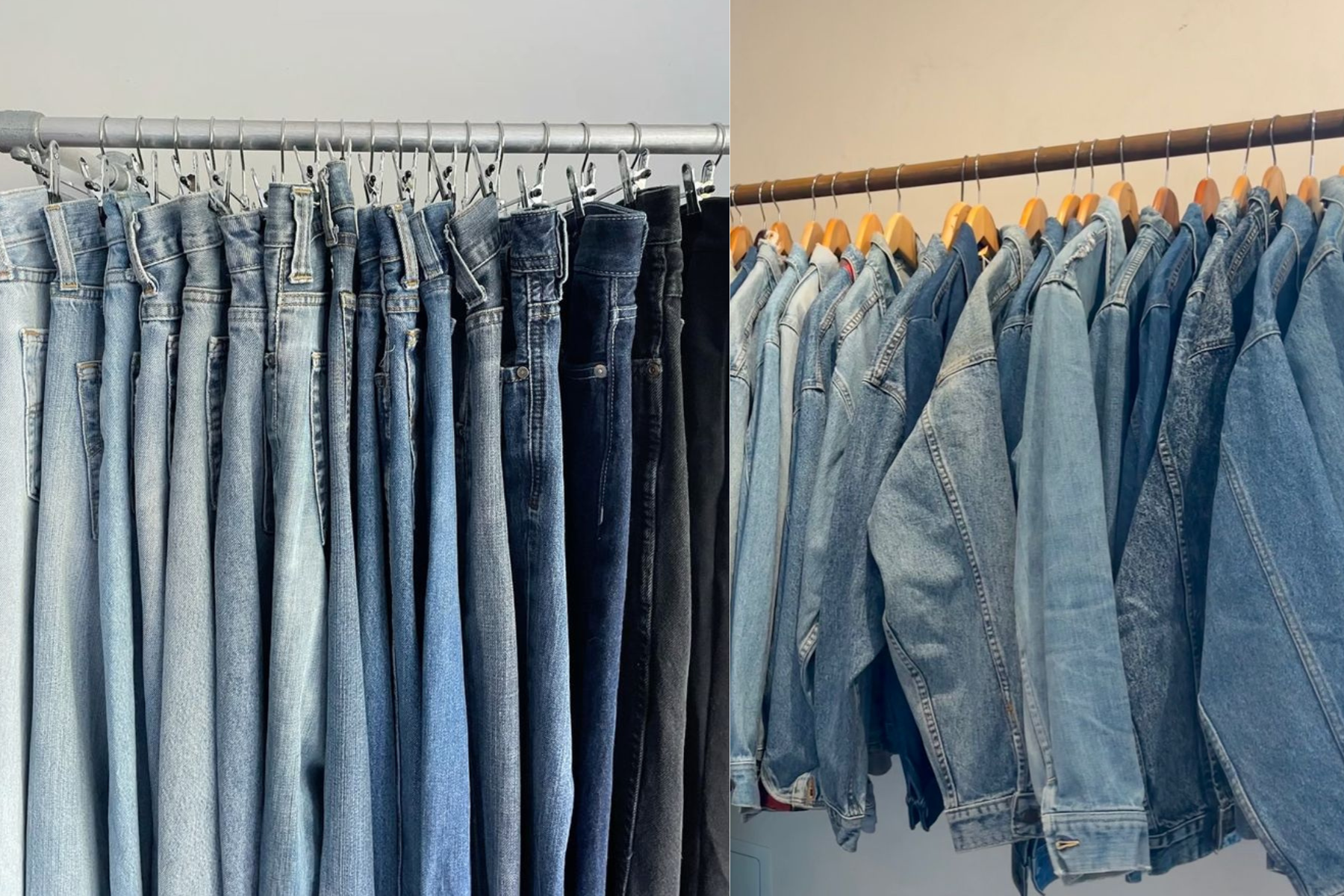
The Levi's pilgrimage. Go to a Levi's store. Pull every cut off the wall, skinny, straight, mom, wide-leg, bootcut, baggy. Try them all. The cut that looks objectively the best on you, tells you something real about your type. Naturals will glow in a relaxed straight. Romantics will glow in something curve-hugging. Dramatics will look long and lean in a slim straight that drowns everyone else. Using the entire denim industry as a giant typing tool. It's actually brilliant.
The friend group session. Get a group of friends in one room, in fitted clothes, and try to type each other. This can work better than typing yourself, because you finally have something to compare against. You can see, with your actual eyes, who has a vertical line and who doesn't. Who has petite scale and who doesn't. Sometimes you can't really see your own vertical, it's like trying to smell your own house. But you can absolutely see your friend's.
The jean jacket test. This is one I wrote about for narrowing between the three automatic Vertical types: Dramatic, Flamboyant Natural, and Soft Dramatic. It's a practical way to figure out whether your body asks for Width or Curve, based on how structured jackets actually fit you.
The idea is that jean jackets, structured blazers, and leather jackets are all cut with narrow, set-in shoulders and a straight, boxy body. Denim doesn't stretch or drape. It just is what it is. That makes it a useful diagnostic, because it shows exactly where your body needs more room.
Three common experiences:
Width. The shoulders and upper back are the problem. You size up to get your shoulders in, but then the torso is roomy. Structured outerwear feels restrictive through the upper body.
Curve. The shoulders fit, but buttoning is the issue. The jacket pulls across the bust, gaps between buttons, or won't close comfortably even when the shoulder fit is perfect.
Narrow. Structured jackets just work. Shoulders sit where they should, buttons close without strain. If something doesn't fit, it's usually a length issue.
Photos can be tricky. Poses, angles, and mirrors all introduce variables. But your lived experience with clothing fit is real data. If you've spent years fighting with structured shoulders, that's worth paying attention to. Same if every button-up jacket treats your bust like an inconvenience.
These DIY methods are scrappy and imperfect, and they still work because they're built on observation, comparison, and the lived experience your closet has already collected for you.
3. The Celebrity Matching Era
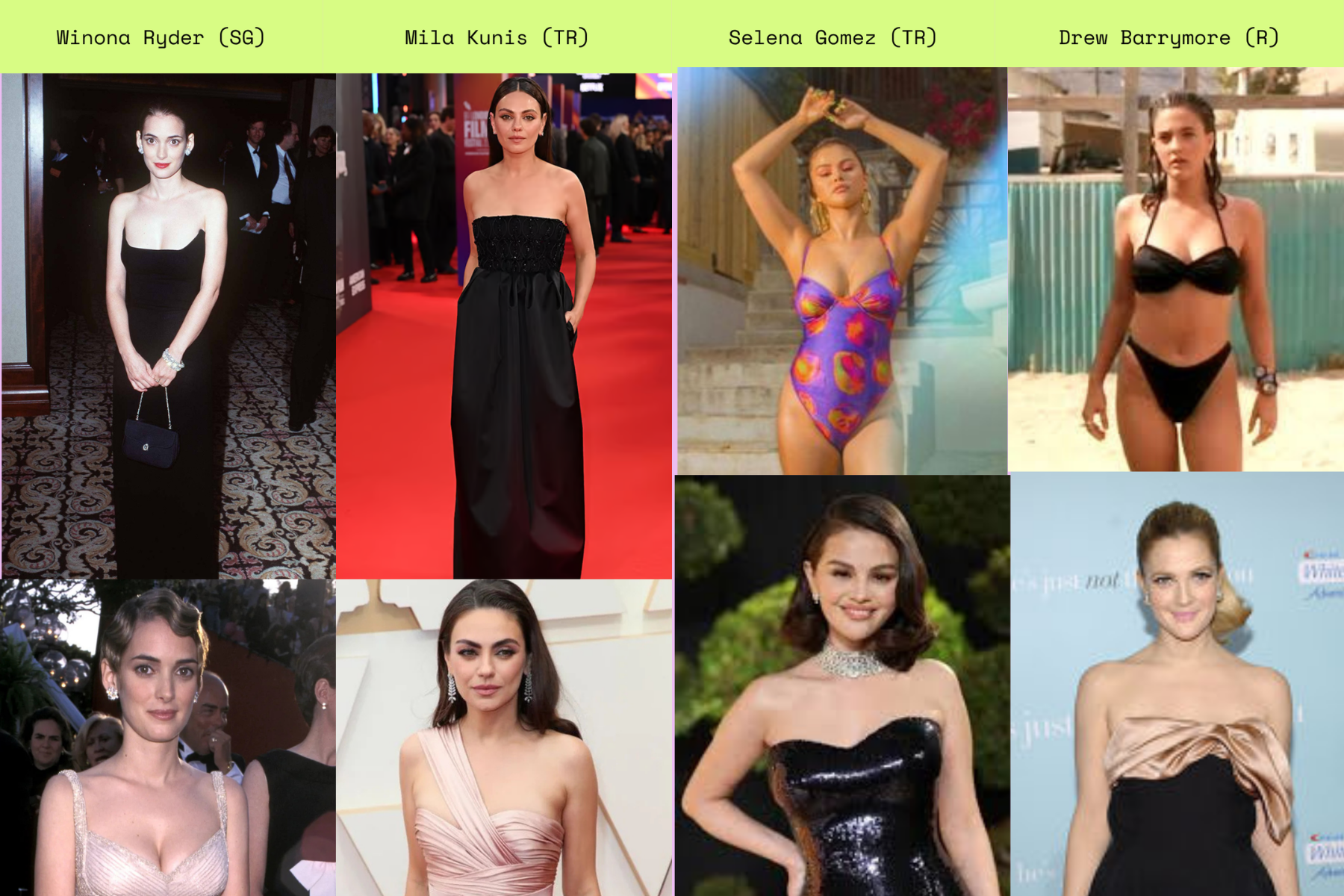
For a while, the dominant method online was finding the verified celebrity you most resembled and claiming their type. Look like Lauren Bacall? You must be Dramatic. Built like Sophia Loren? Soft Dramatic. Read like Audrey Hepburn? Flamboyant Gamine.
There's something useful here, David's verified celebrity list is the closest thing we have to a ground truth, and matching your overall impression to a verified type can point you in the right direction.
But it's also where a lot of people went wrong. Celebrities are styled. They're lit, posed, photographed by professionals, and edited. You're matching yourself to a presentation, not a body. And celebrities don't represent every variation of a type, Soft Naturals don't all look like Goldie Hawn, and Romantics don't all look like Marilyn Monroe.
The celebrity library is still one of the most valuable tools we have. It's just not a typing method on its own. It's a reference, not a verdict.
4. Reddit and the Polling Era
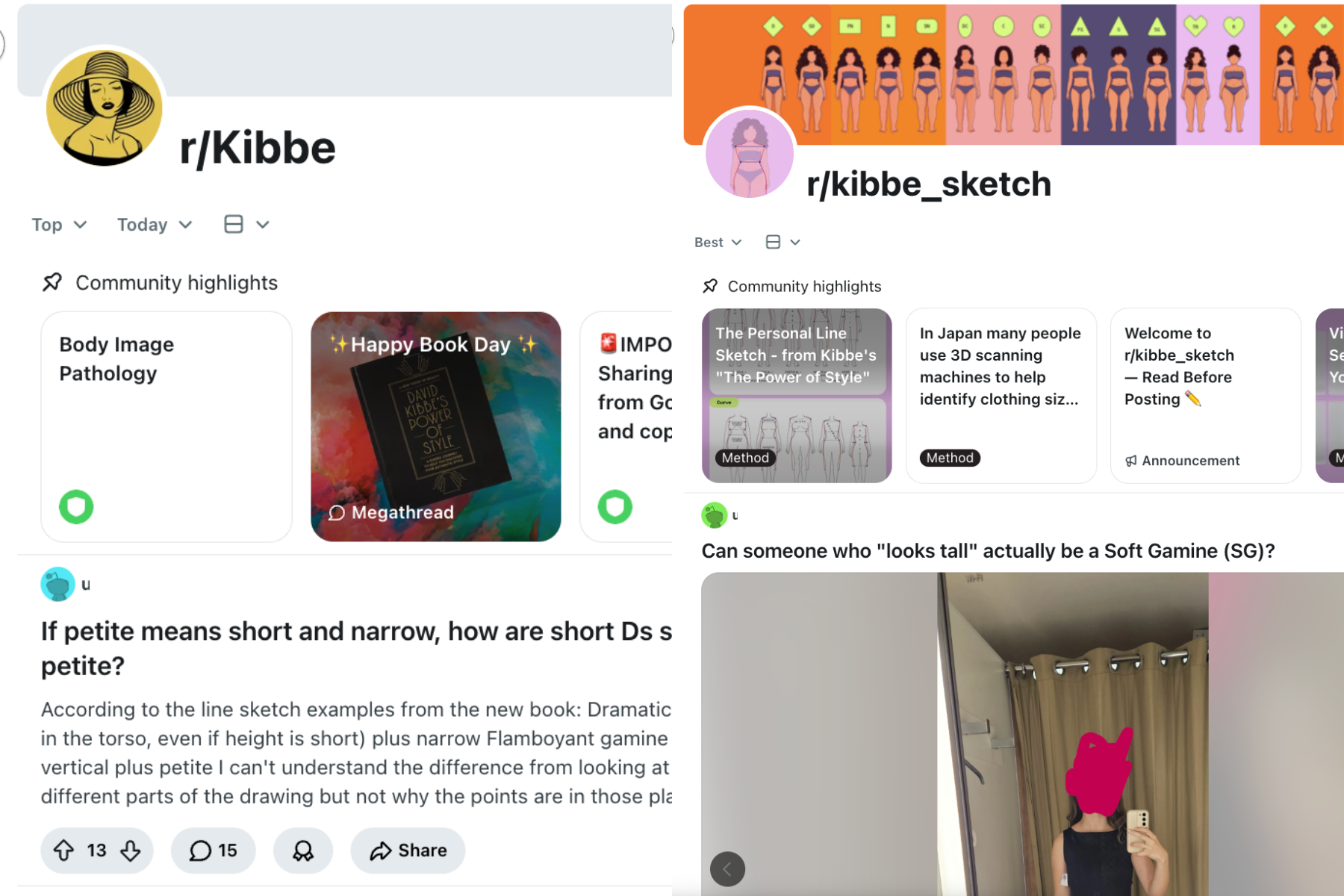
Then came the subreddits. r/Kibbe, and a dozen smaller communities where people would post photos and ask strangers to tell them their type.
I love these communities. The collective knowledge is real, the curiosity is real, and some of the most insightful Kibbe minds I've encountered have been Redditors.
But the data is humbling. From a 2024 read of every publicly available "type me" post on r/kibbe_typeme, only about 39% ever reached a clear consensus in the comments. The rest got a split jury (if they got a response at all), three votes for Soft Natural, two for Romantic, one for Soft Classic, with most replies being just two letters and out. You left more confused than when you arrived.
Then came r/kibbe_sketch, the most recent typing community. It's a space that attempts to push past the two-letter verdict, somewhere the community can come together and note what we actually see, gather around real observation, and document patterns and case studies as we go.
Even at their best, the fundamentals don't change. Typing from individual features, by individual strangers, in individual photos with different lighting, is genuinely hard. The system needed something more structured.
5. Kibbe Facebook Group
Around the same time the online communities were growing, the Strictly Kibbe Facebook group was building its own version of the conversation. It's been running since 2015, and is tightly moderated.
The rules are strict by design: nothing outside David's published framework, no YouTube interpretations or third-party content, no celebrity discussion beyond his verified list. The hand on the wheel is the point. If something hasn't come from David, it doesn't belong in there.
Members post their Personal Line sketches and get feedback from other members and admins, similar to r/kibbe_sketch. The distinctive pull, though, is that David himself sometimes comments (posting under his wife Susan Slavin's account, since the group is women-only). Direct feedback from David on your own sketch is rare, and it's the closest most people will get to a real Kibbe verdict short of the in-person appointment.
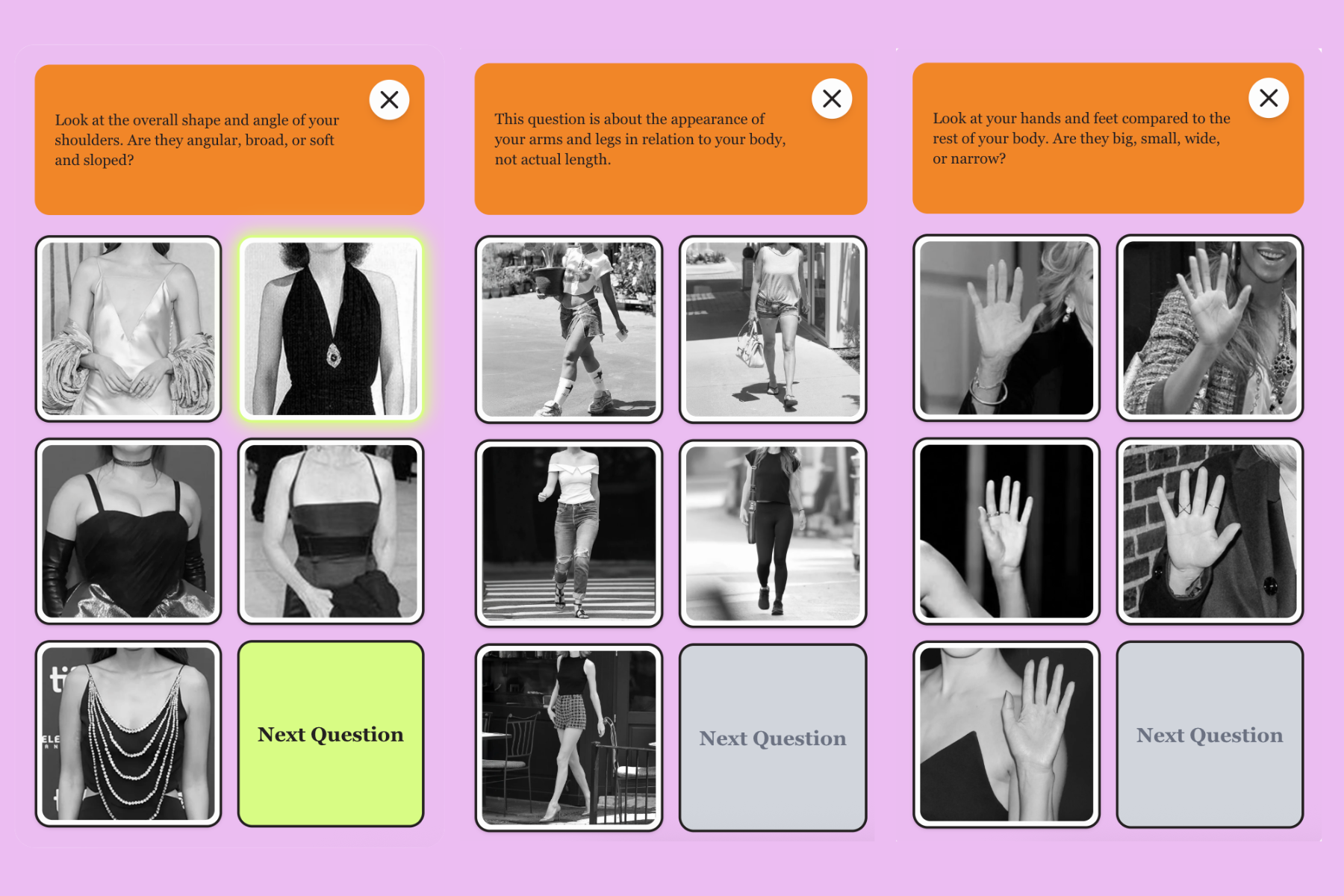
6. The Modern Weighted Quiz
When I built the quiz on this site, I wanted to honor the original framework while fixing what felt broken about it. The biggest fix was weighting.
Not every feature carries the same diagnostic power. Your shoulder structure tells us a lot. Your hand size, frankly, tells us almost nothing. The new quiz reflects that. The questions that actually move the needle on your type get more weight, and the ones that are mostly noise get dialed down.
The other fix was visual. Every answer to every question comes with both a written description and image examples. You don't have to guess what "blunt shoulders" or "tapered hips" actually look like, you can see them. The original quiz asked you to interpret features you'd never thought about, with no reference for what the options actually meant. The modern version shows you.
It's still a quiz. It still has all the limits of a quiz. But it's a much better quiz than equal-weight A-through-E tallying, and for people who prefer to answer questions over uploading photos, it gets a lot closer to the truth.
7. Standard Photo Analysis
For people who'd rather upload photos than answer questions, the next step was automated photo analysis. The idea was simple: instead of asking you to interpret your own body, let an advanced measurement system do the reading.
You upload some photos. The system extracts the key proportions automatically. Shoulder width relative to hip width. Vertical line. Waist definition, Flesh vs Frame. The proportional ratios that actually drive Kibbe typing. No tape measure, no hand spans for scale, just photos.
This is solid technology. Accuracy lands at around 76% on verified typings, a meaningful improvement over self-typing and the kind of method that closes the gap between "I think I'm Soft Natural" and "the math says I'm Soft Natural."
8. The Sketching Method (Power of Style, 2025)
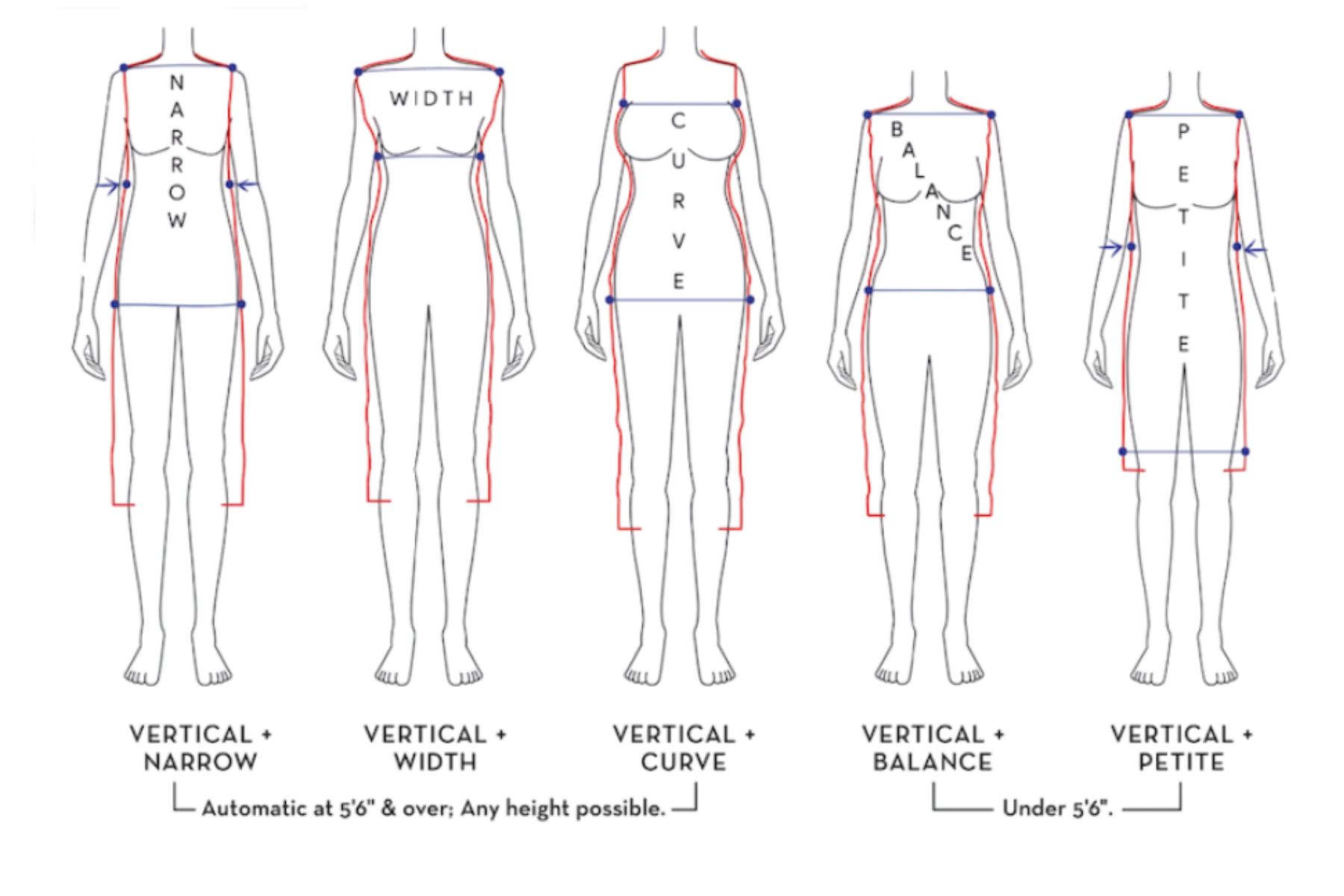
While I was trying to advance typing technology, David himself was working on the same problem from a completely different angle. In his 2025 book Power of Style, he introduced the Personal Line, a sketch of how your body's proportions relate to each other in one long outline.
The method is beautiful. You take a full-body photo in fitted clothing. You imagine silk chiffon, weighted at the bottom, draped from your shoulders. If the chiffon falls relatively straight down, your Dominant is Vertical. If it gets pushed out by your bust or hips, your Dominant is Curve. Then you find your Additional, Narrow, Width, Curve, Balance, Petite, or Double Curve, based on where your secondary characteristic shows up on the body.
Dominant + Additional = your Personal Line. Your Personal Line maps to your Image Identity. It's elegant, it's grounded in what fabric actually does on a body, and it's the closest thing the Kibbe system has ever had to a unified theory.
9. The 3D Body Mesh
This is the method I'm most excited about, and it's the one that can give Kibbe typing real objectivity.
The ceiling on photo analysis is the photos themselves. They're 2D snapshots of a 3D object. Some structural cues, depth, the way curves push outward, the relationships between parts of a body in three dimensions, get flattened in a way no algorithm can fully recover.
The inspiration came from Japan, where 3D body modeling is already standard infrastructure across the fashion industry.
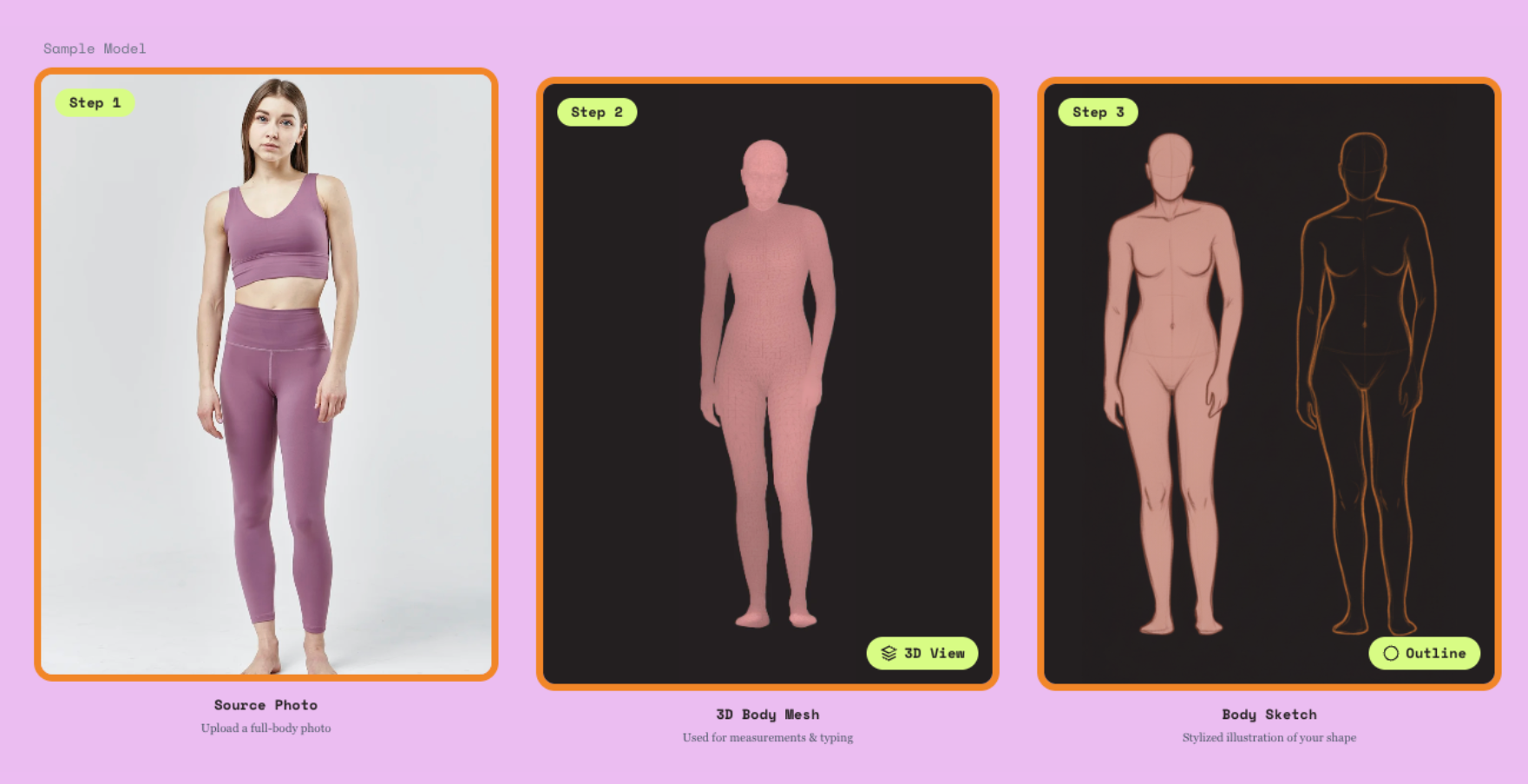
You upload a full-body photo. The system generates a 3D body mesh of your proportions, and reads your Dominant and Additional from the geometry. Alongside the 3D-Digital version of your frame, the system also produces a digitalized sketch to help you visualize your lines.
The model was trained on verified Kibbe typings, and the accuracy rate landed at 86%. Almost nine times out of ten, the system reads correctly against verified ground truth. For anyone who's lost a weekend to Reddit polls and celebrity matching, that's a significant leap.
The first line of David's original book is: "...learn to look at yourself objectively. To see yourself not as you wish you were, or as you wish you weren't, but as you actually exist."
The 3D mesh is the literal expression of that line. It removes the part of typing that has always been hardest, your own eye looking at your own body, and replaces it with geometry. Try it today!
10. Virtual Try-On
Typing is the beginning, not the end. The whole point of Kibbe is figuring out what your body needs to accommodate, what silhouettes work with you instead of against you.
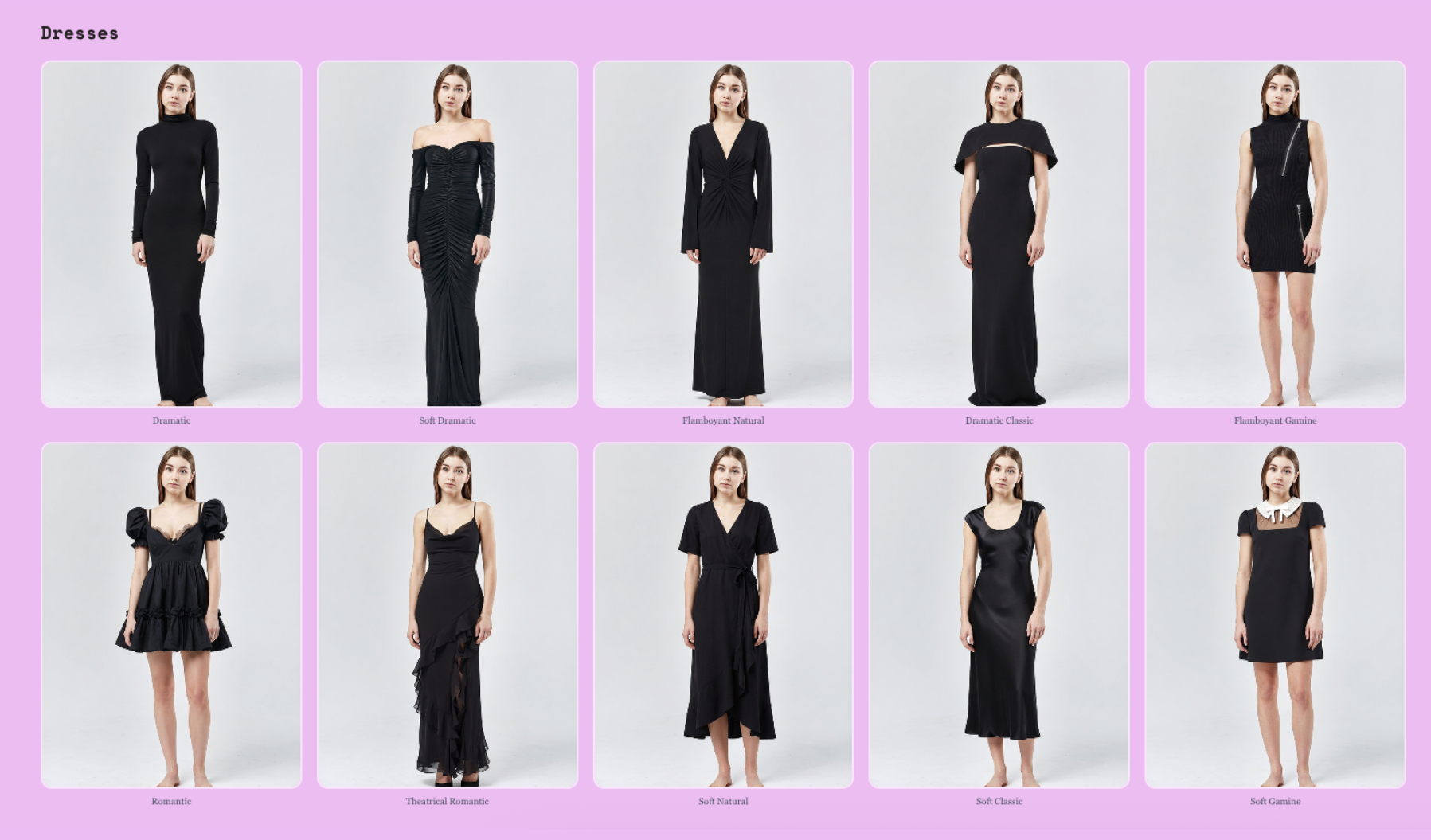
So I added virtual try-on to every premium analysis. Once you have your type, you can see your body in the signature silhouette of every Kibbe type, dresses and outfits, all 10 types. You can see, with your own eyes, why a Romantic silhouette pulls on you differently than a Dramatic one. You can see what your body asks for.
This is the part that closes the loop. Knowing you're Soft Gamine means nothing if you can't visualize what a Soft Gamine silhouette looks like on you specifically. Virtual try-on is the answer to "okay, so now what?"
11. In-Person Appointment With David Kibbe
After every digital tool and every community, the original answer to "how do I find my Kibbe type" is still the same: go see David himself. He offers in-person appointments in New York for around $5,000. The session spans 3 days, with about 6 of those hours spent directly with Kibbe.
He calls it the David Kibbe Experience and structures it as a three-step journey: Discovery, Transformation, and Fruition. The Discovery step is the typing itself, the official Certified Kibbe Analysis, which includes your Image Identity™, Kibbe Color™, and DK Couture Cosmetics™. The remaining steps translate that analysis into a personalized wardrobe, hair design, and makeup technique, a complete head-to-toe styling done with him directly.
This is the ground truth. The most authoritative read possible, and the only one that comes directly from the source. If money is no object and you want a verdict from David himself, this is it. Juniper Journeys documented her experience over on Youtube if you are curious.
What a Premium Analysis Includes
A premium analysis on the Kibbe Body site bundles the three modern methods into one package. You get the 3D body mesh of your own body, the sketch output traced from that mesh, and virtual try-ons that show you what each Kibbe silhouette actually looks like on you. The mesh gives you the answer. The sketch shows you the geometry behind it. The try-ons turn the answer into something you can actually wear.
Premium also includes the option of a manual review from me (Lani), where I work through David's sketching method on your photos by hand and often pull in celebrity comparisons to help orient you against verified examples. The premium analysis tools give you objectivity. The manual review adds the human eye. Together, it's the most complete visual read of yourself the system can offer.
So Which Method Should You Actually Use?
Each method does something a little different. The trick is knowing what each one is for.
Start with the books. Metamorphosis and Power of Style are the source material. They might leave you confused, and that's fine, most of us are confused after the first read. Sitting with that confusion is part of how you build the eye.
Photo analysis gives you the most accurate single answer. Pick the standard read or the full 3D body mesh, depending on how deep you want to go.
Virtual try-ons show you what works and what doesn't on your specific body. Specific necklines, shoulder shapes, lengths, levels of softness, all of it, on your frame instead of a model's.
The quiz is a good double-check. If your photo result and your quiz result agree, that's confidence. If they don't, that's worth investigating.
Reddit posting is great for community feedback and a sanity check, but don't go in expecting consensus. Treat it as a conversation, as information gathering, not a verdict.
A friend group session works because you finally have something to compare against. You can't see your own vertical line, but you can see your friend's, and that often clears up the confusion fast.
An in-person appointment with David Kibbe. The gold standard. The cost is over $5,000, but you walk out with a verified Image ID directly from the source.
The goal isn't to find the one true method. The goal is to understand your body well enough that the answer becomes obvious, and every method that helps you get there is a method worth using.
Related Articles
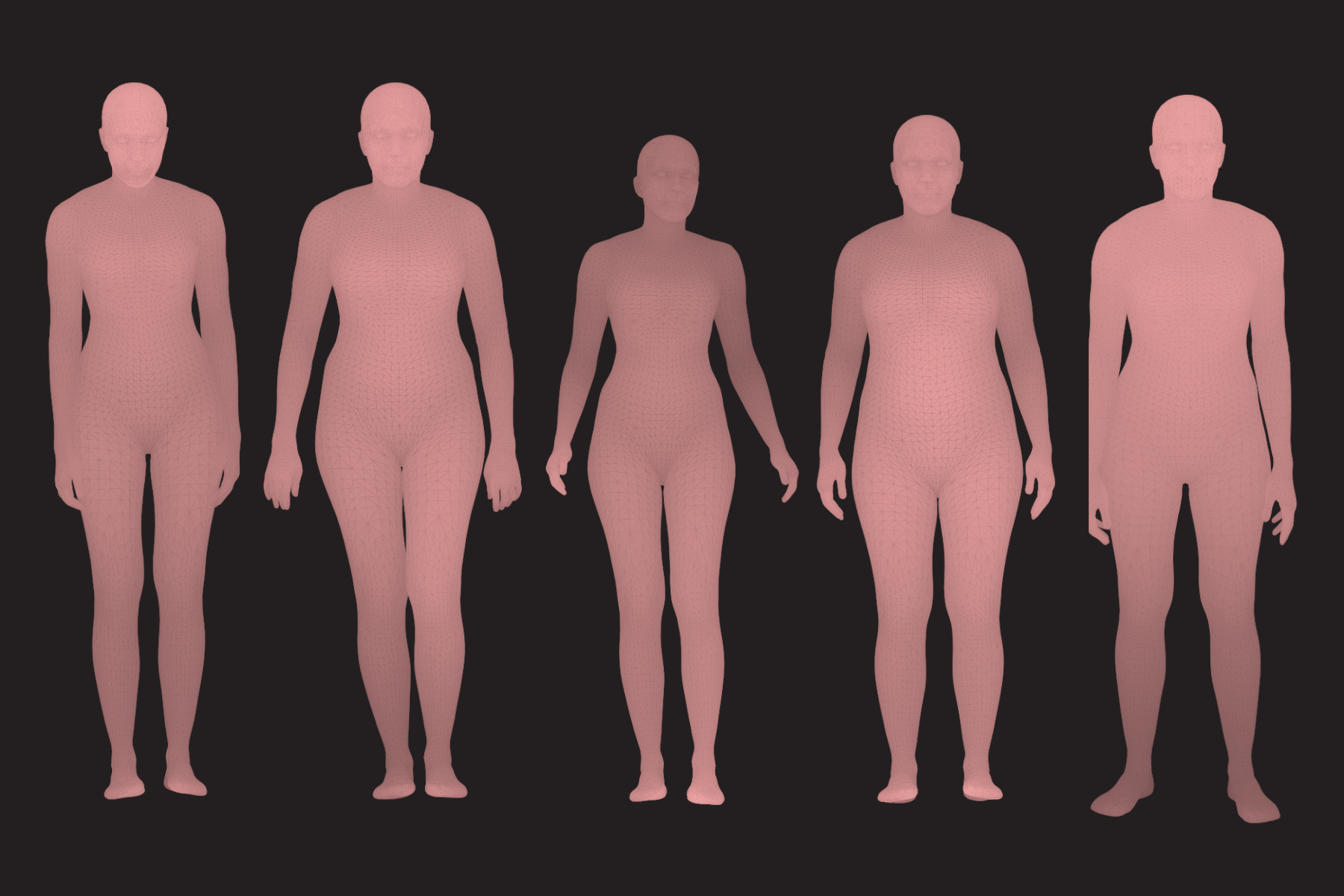
How Japan's 3D Body Scanning Technology Is Changing Kibbe Body Typing
A printout on my kitchen counterMy friend Jas came back from a two-week trip to Japan with the usual haul (a Muji tote, two bags of strange snacks, three skincare products I'd never heard of) and one...

Shoulder Dot Placement in the Kibbe Personal Line Sketch
Let's talk about something that comes up constantly, quietly causes a lot of confusion, and genuinely affects how accurate your sketch reads: where do the shoulder dots go?This is one of those topics...
A Devoted Reader's Notes on the Kibbe System
David Kibbe built something important. The core insight at the heart of his system is that you should feel beautiful, and that clothes should be chosen to accommodate the body wearing them. This...